Al-Qalam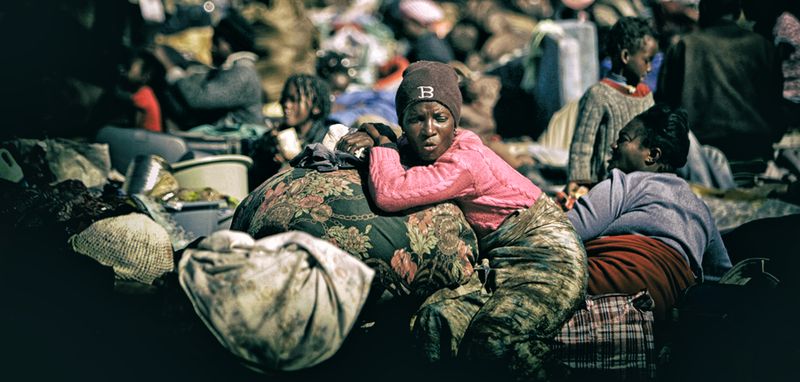
By Imam A. Rashied Omar
What we are witnessing in South Africa is not simply xenophobia, a general fear of foreigners. It is Afrophobia: hostility directed specifically at black African migrants from north of the Limpopo River, while white foreigners from Europe are often welcomed, celebrated, or viewed entirely differently. This selective hostility exposes something far more painful than economic anxiety: it is the symptom of a deep wound in our collective psyche, a self-hatred implanted by centuries of colonialism and apartheid, that we now turn outward onto those who most resemble us.
This is why Afrophobia cannot be explained away as nativism or economic concern dressed up in civic language. It is anti-black racism directed at fellow Africans, the internalisation of colonial and apartheid hierarchies of race and worth, now replayed by the very people those hierarchies were designed to crush. And to understand it, we must be willing to look into a mirror we have long refused to face.
What the mirror reveals, psychologists call self-projection: the unconscious process by which we take the parts of ourselves we have been taught to despise and cast them onto others, attacking in them what we cannot bear in ourselves. Three and a half centuries of colonialism and apartheid did not merely dispossess black South Africans of land, labour and dignity. They waged a sustained assault on black self-worth itself. Generations were told, in law and in liturgy, in classroom and in workplace, that blackness meant inferiority, backwardness, criminality. Steve Biko understood this when he wrote that the most potent weapon in the hands of the oppressor is the mind of the oppressed. Frantz Fanon had diagnosed it decades earlier: the colonised subject, saturated in the coloniser’s contempt, comes to see himself through the coloniser’s eyes. This is self-hatred in its purest form, and self-hatred, left unhealed, does not stay inside. It seeks a target.


And the target it finds is close to home. The poison of internalised contempt does not evaporate with a new flag and a new constitution. It settles into the subconscious and waits. So when a wounded people encounters a stranger who looks like them, darker, perhaps, poorer, speaking an unfamiliar African tongue, the stranger becomes a screen onto which all that internalised shame is projected The Zimbabwean labourer, the Mozambican mechanic, the Malawian mu`adh-dhin and the Somalian shopkeeper: are attacked not because they are foreign, but because they are black and foreign. They embody, in the distorted mirror of the colonised mind, everything we were taught to hate about ourselves. The violence directed at them is, at its root, violence against our own reflection.
Once we understand this, the puzzle of selective hostility solves itself. This is why the European, American, and Asian migrant walks unmolested through our streets while the African migrant’s shop burns. Whiteness was installed at the summit of the colonial hierarchy of worth, and that hierarchy still governs the subconscious, even of those it crushed. To defer to the fair-skinned foreigner while brutalising the dark-skinned one is no coincidence. It is the colonial order reproducing itself through the hands of its former victims. Can black people internalise racism and despise their own blackness without even knowing it? The evidence burns in our townships.



If the diagnosis is self-hatred, then for Muslims the cure begins with Divine revelation. The Qur’an, in Surah al-Rum (30:22), proclaims that “among the signs of Allah are the creation of the heavens and the earth and the diversity of our languages and our skin colours”. Our different tongues and our different shades of skin are not accidents to be ranked, nor flaws to be despised; they are ayat, Divine signs. To celebrate this diversity is to affirm a sign of Allah in creation. To despise the darkness of another’s skin, or, through projection, the darkness of one’s own, is to turn in contempt from a sign of Allah in the universe. The Prophet Muhammad, peace be upon him, sealed this teaching in his final sermon when he proclaimed: no Arab has superiority over a non-Arab, nor white over black, except in God-consciousness (taqwa).
Healing, however, begins with honesty. We must find the courage to name Afrophobia for what it is: self-hatred turned outward. And then we must undertake the harder, slower work, decolonising our minds, reclaiming the dignity of our blackness as a sign of Allah, and rebuilding the Pan-African solidarity that carried us to freedom. The black stranger at our door is not our enemy. He or she is our brother and sister, and our mirror. Until we can look into that mirror without flinching, the fires will keep burning. When at last we can, we will see reflected there what Steve Biko declared in defiance and what Allah had proclaimed in revelation long before: Black is Beautiful, for black skin is among the signs of Allah, and every sign of Allah is beautiful.