Al-Qalam
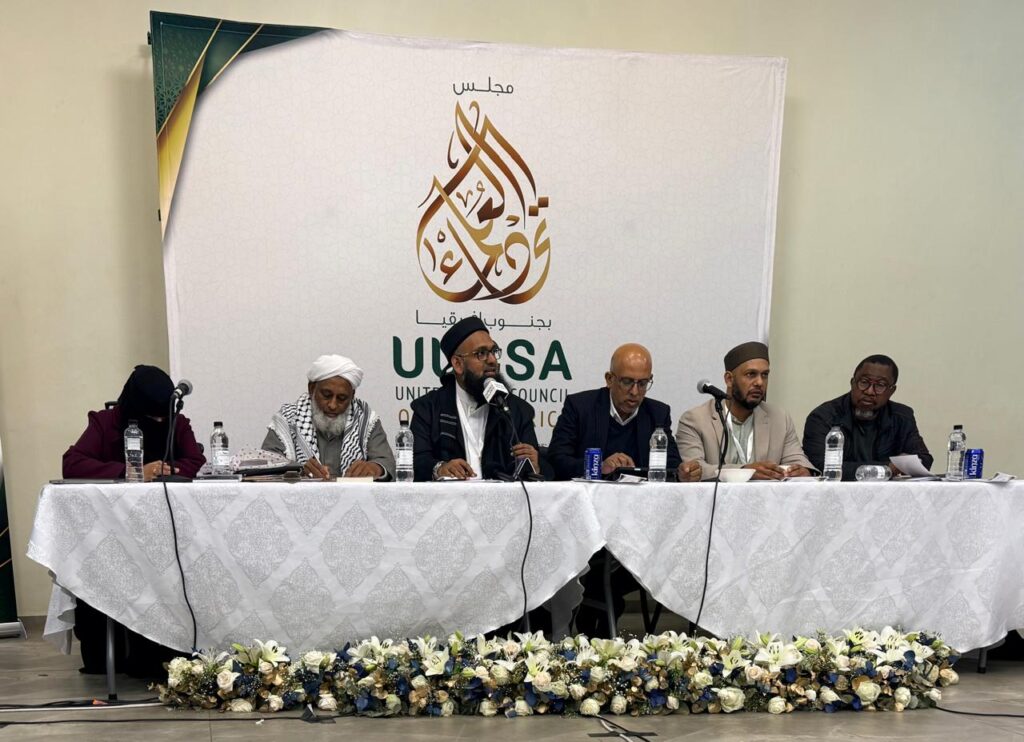
UUCSA’s Political Party Report Card and the MJC’s fatwa offer guidance on the responsibilities of Muslim voters, Fazlin Fransman-Taliep reports.
With the 4 November local government elections days away, South Africa’s Muslim voters face a question that cannot be answered by service delivery statistics alone: what happens when a political party’s record in government conflicts with the moral principles of those being asked to vote for it?
Two interventions by the country’s ‘Ulama have brought that question into focus: the United Ulama Council of South Africa’s (UUCSA) Political Party Report Card and a fatwa issued by the Muslim Judicial Council (MJC) on the religious consequences of supporting parties that endorse or justify unlawful killing.
Released on 26 October, the UUCSA Political Party Report Card assesses eight political parties: the African National Congress (ANC), Democratic Alliance (DA), Economic Freedom Fighters (EFF), uMkhonto weSizwe (MK), Inkatha Freedom Party (IFP), ActionSA, RISE Mzansi and Al Jama-ah.
The assessment examines seven priorities identified through the June 2026 Civic Indaba: youth unemployment; public health; climate and environmental justice; corruption and procurement transparency; online gambling; crime and Islamophobia; and Palestine and foreign policy coherence.
Importantly, the Report Card distinguishes between policy commitments and implementation records, examining not only what political parties promise but what they have delivered.


UUCSA Political Strategy Committee chairperson Moulana Sulaimaan Ravat explained in a statement:
“Each assessment examines the party’s policy positions, implementation record, arguments in favour of electoral support and reasons for withholding that support.”
For voters confronting unemployment, deteriorating municipal services, housing shortages and rising living costs, the assessment provides a means of scrutinising political claims against demonstrated performance.
Ravat was equally clear about the organisation’s political independence.
“The UUCSA Political Party Report Card does not endorse any political party or prescribe a single Muslim vote. Nor should differences in political judgement be used to question an individual’s faith.”
On the inclusion of Palestine, Ravat stated: “The inclusion of Palestine is deliberate and principled. While foreign policy falls outside municipal jurisdiction, a political party’s response to genocide remains relevant to evaluating its commitment to justice, human dignity and the sanctity of life.”
When political support becomes a religious question
Separately, the MJC Fatwa Committee has issued a ruling addressing whether Muslims may knowingly support political parties that endorse, justify or materially assist the unlawful killing of human beings.
The ruling concludes: “Knowingly extending support, whether through votes, campaign efforts, financial aid, or public endorsement, would constitute prohibited cooperation and would be sinful.”
Explaining the fatwa on behalf of the MJC, Moulana Zakariya Harneker identified two foundational Islamic principles: the sanctity of human life and the Qur’anic prohibition against cooperation in sin and aggression.



He referenced the Qur’anic teaching that killing a single innocent soul is akin to killing all humanity, alongside the injunction, “Wa la ta’awanu ‘alal-ithmi wal-‘udwan”, which prohibits cooperation in sin and aggression.
“It is haram to aid somebody in something that is haram, that is impermissible,” he explained.
Harneker argued that supporting a political party engaged in such conduct was no different in principle from supporting an individual responsible for the same wrongdoing.
Gaza and the limits of political endorsement
The application of the MJC fatwa to political statements concerning Gaza raises particularly consequential questions.
On 11 October 2023, the Democratic Alliance issued a statement declaring: “We recognize Israel’s right to defend herself and protect her people.”
Harneker was asked directly whether a political party making such a statement would meet the fatwa’s criteria concerning the justification of unlawful killing.
“Certainly, I would say so,” he responded.
“Everybody with a sane mind can recognise when a genocide is happening, when innocent people are being killed, when you are not simply attempting to defend yourself.”
His response represents his application of the fatwa’s principles to a specific political statement, rather than a separate formal ruling naming the DA. It is also distinct from UUCSA’s independent political assessment.
The distinction is significant. The Report Card evaluates political parties across defined areas of public policy and governance, while the MJC fatwa establishes the religious principles governing support for parties that meet its stated criteria.
Shaykh Ihsaan Taliep, reflecting on the fatwa, challenged the argument that local government elections should be judged solely through service delivery.
He contrasted potholes in South African streets with the bomb craters left in Gaza, questioning whether efficient municipal administration could outweigh fundamental questions of justice.
Taliep also challenged claims of uniformly efficient service delivery in Cape Town, highlighting disparities between affluent suburbs and communities on the Cape Flats.
For Taliep, voting itself carries religious significance.
“So, in the Islamic vocabulary, this is a form of Shahada,” he explained, describing the ballot as testimony through which citizens delegate authority and empower political leadership.
“I’m not even only endorsing them. I’m giving them power.”