Al-Qalam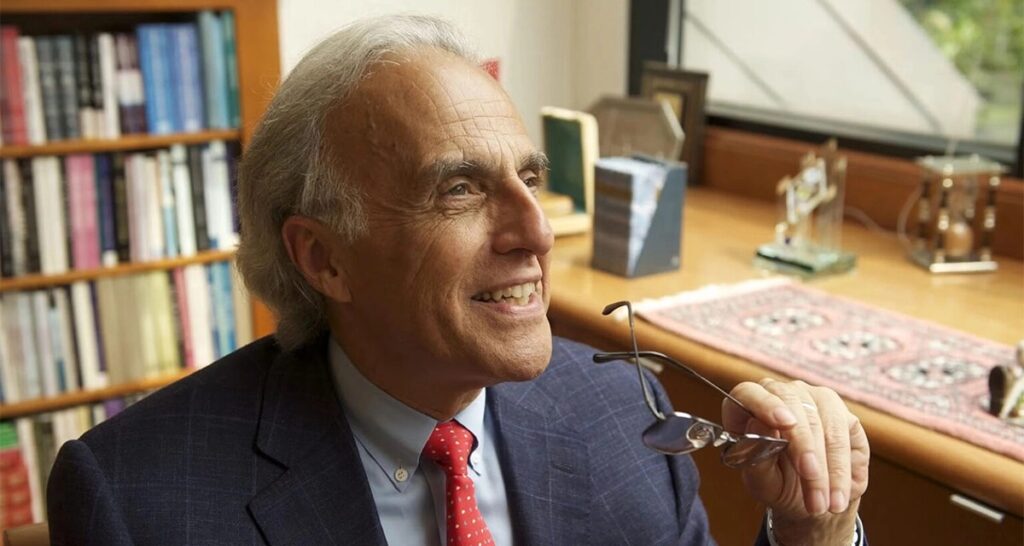
By Ebrahim Rasool (Former Ambassador to the USA)
On July 15, 2026, my flow of birthday wishes was interrupted with news more consequential, but mournfully sad: John Louis Esposito, at the age of 86, was no more. Sombreness overwhelmed me, and I counted back the almost four decades since I first encountered him, as one of those who were curiously excited about the South African transition, the presidency of Nelson Mandela, Desmond Tutu’s witness, and the prospects for a new future free from all discriminations following the travesty of apartheid.
In the last decade, I had the wonderful privilege and honour (for two years) to encounter him up close at Georgetown University in the USA. He had accepted to host me as Distinguished Scholar in Residence in the Al Waleed bin Talal Center for Muslim Christian Understanding (ACMCU), following my stint as South African Ambassador to the USA under President Obama. Up to that moment, we had encountered each other regularly across the world, in conferences and seminars, at think tanks during the halcyon years of the Arab Spring, and anywhere else where Islam and its shadow, islamophobia, were on the agenda.
Most memorably, in 2012, John Esposito and I were two of probably only 15 participants in Doha with key leaders of the Arab Spring who were gathered to consider Constitution-Making and Statecraft in what we hoped would be a qualitative leap out of authoritarianism. He was the only one who was not Muslim among eminent scholars like Yusuf al Qardawi, Hassan al Turabi, Jasser Auda, Tariq Ramadan, Hashim Kamali, and others. While the Muslims were cautiously optimistic, Esposito doubted that the Empire and their minions could accept a Muslim world with an alternative liberatory statecraft, and without the confirmation bias of Muslims being – without cause – naturally extreme and therefore, in need of strong authoritarian law and order regimes. These were the critical informants to a pervasive islamophobia.


It was this dual insight – the yearning of Muslims to live with dignity, as well as the fundamental, if not deliberate, Western distortion of Islam, Islamism, and the Muslim – that made John Esposito different. He was a different Christian, a different American, a different academic, a different human being! These identities did not make an aberration of John Esposito. He would insist that because he was Christian, American, an academic, and a human being, he needed to testify to the truth inherent in each of those identities: his own faith made him recognise the profound faithfulness of Muslims; his own Americanness made him desire freedom, democracy and rights for Muslims under authoritarianism or extremism; his academic training made him uncompromising on rigour and evidence; and his humaneness created in him a deep well of human empathy and compassion. By this definition, right-wing evangelicals were the aberration; American support for tyranny and warmongering was the aberration; moral clarity produced by academic scholarship without the requisite moral courage to act was the aberration; and human silence and complicity in atrocity were the aberrations in the human condition.
In his scholarship of Islam and Muslims, in his development and mentoring of Muslim scholars, in his friendship with Muslim leaders, in his writing of over 50 books about Islam and Muslims, in his activism against islamophobia, in his advocacy for a shift in policy and law about Muslims, and in his institution-building like the Bridge Initiative, John Esposito was neither oracle nor orientalist. He was neither our source of guidance and wisdom, nor were we the exotic other to study. He did not speak for us, or about us without us. But his scholarship gave him the insight and understanding of Islam and Muslims, the sincere representation of which gave him the credibility of an insider-outsider both for Muslims and most non-Muslims. Because he studied with rigour, he understood with empathy, and he could interpret with integrity, free of the emotion that comes too easily to victims of history. So, he did not infantilise Muslims.
But neither did he idealise us. He was a witness to the battle for the narrative and interpretation of the Quran and Sunnah; for their appropriation either for the middle ground or the extremes; and for their application under conditions of minority or majority – believing firmly that application may change but the Maqasid, the intents, remain unshakeable! Because he applied academic rigour and stood on evidence, he could dispassionately critique Muslims about the management of our own unresolved demons and ambiguities ranging from the ‘other’ to gender to politics to sectarianism. But always as the sensitive and compassionate outsider-insider.



But he was also a thorough insider to all things Christian and American. He shared their rituals and celebrations, but he also knew their suppositions and presumptions about Islam and Muslims. The most pernicious of these excused occupation and genocide; gave license and arms to authoritarians; allowed islamophobia to fashion travel bans and unspeakable bigotry, especially after 9.11; and wage a forever war on the Muslim heartlands. All because the theory espoused was one of the modernisation of the Muslim ‘other’– which Esposito vigorously critiqued – because its corollary, secularisation, the stripping of religious sensibility from the Muslim, was not only misplaced, but would invite resentment and blowback, and thus breed the next generation of extremists. All of this made John Esposito dangerous to the empire and the superpower. He was constantly attacked by detractors in the Western conservative ranks for seemingly endorsing our fault lines and for acting as a Trojan horse for bringing Muslim scholars to the USA, where they flourished without the burdens of violent occupation, authoritarian surveillance, and stultifying orthodoxy.
Deservedly, tributes have poured in for John Esposito and messages of condolences for his beloved Jean and their dogs. All of these have fulsomely recognised his contribution to Islam, Muslims, and humanity. These have focused on his writing and his bridge-building. Muslim tributes have cautiously tried to manage the fine line between an instinctive desire to recognise in him one worthy of the highest honour in this world and the next while managing the strictures of soteriology – the theology of salvation – which inhibits us from showering even a fraction of our prayers on those imbued with absolute nobility and impact. Yet the tributes have touched the fine line: Many have invoked the Quranic formula that we originate with Allah and we return to Allah; Anwar Ibrahim describes him as a ‘true friend of the Muslim World’; Arsalan Iftikhar muses that John Esposito ‘… did more for educating the world about Islam than most of our two billion Muslims…”; and Jonathan Brown, who succeeded Esposito at the ACMCU, prays ‘May God grant his soul mercy.’
*Ebrahim Rasool is the Former Ambassador to the USA and Senior Fellow at Georgetown University.