Listening before leading: What young Muslims taught me about becoming Ambassadors for Change
 Al-Qalam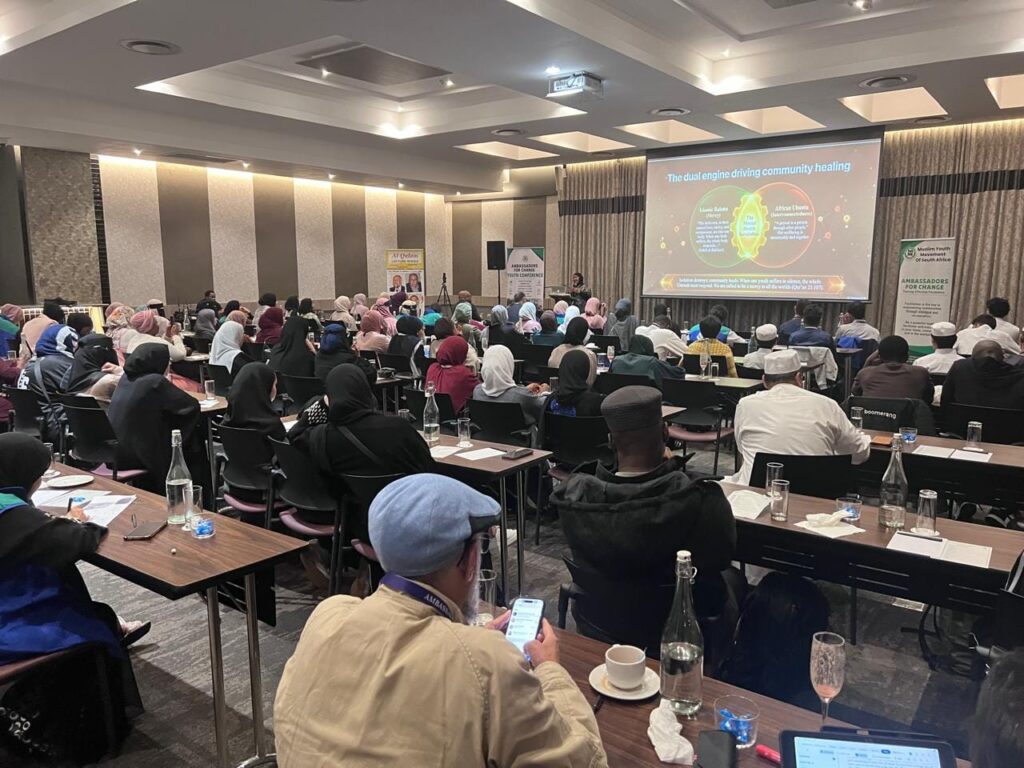
By Aslam Fataar
I had the privilege of addressing the Muslim Youth Movement’s (MYM) ‘Ambassadors for Change’ Youth Conference in Durban on 11 July 2026. The conference marked the culmination of the MYM’s five-year Ambassadors for Change youth development programme while laying the foundation for its ongoing work to nurture ethically grounded young Muslim leaders. Its theme, “It is in the hands of the youth to give the world a more humane face,” reflected both the urgency and hope that characterised the gathering.
As I walked into the conference hall, I carried a quiet sense of nervousness. Many years have passed since I served as Deputy President of the MYM, and I wondered whether there was now too great a generational distance between myself and the young people before me. They inhabit digital, social and political worlds profoundly different from those in which my generation came of age.
Those concerns quickly disappeared. The day reminded me that one of the greatest responsibilities of older generations is not first to speak but to listen. The Qur’an praises those “who listen to the word and follow the best of it” (Qur’an 39:18). Listening is itself an ethical act and, I believe, the starting point for meaningful intergenerational engagement.
The First Responsibility: Listen
I attended not only as a speaker but also as an academic leader of Stellenbosch University’s Dialogue, Democracy and Development project, which seeks to cultivate dialogue across social, cultural and political differences. Throughout the day, I listened carefully to every presentation, filling pages with notes as these young Muslims spoke honestly about artificial intelligence, social media, mental health, leadership, conflict and their search for meaningful lives rooted in faith.


I learnt tremendously from this process of listening. I left convinced that careful listening must become a cornerstone of our ethical engagement with Muslim youth. Too often, adults speak about young people before genuinely listening to how they understand the worlds in which they are mired and how they seek to exercise their God-given human agency.
The conference itself reflected years of patient educational work. Organised for and by the MYM’s youth organisers, it represented the fruit of sustained investment in ethical leadership. I particularly wish to acknowledge Asif Essop, whose longstanding commitment to the MYM and to youth development made him a central part of this remarkable initiative.
The Fires of Our Age
My own presentation drew on the central framework of my recently edited volume, ‘Prophet Muhammad at 1500: His Prophetic Legacy, Ethical Vision and Contemporary Resonance’ (Fataar, 2026). The book argues that the Prophetic legacy offers an enduring ethical grammar for responding to the moral, social and political challenges of our age.
I invited the audience to reflect on what I called ‘Niran al-‘Alam’ – the fires consuming our world. These fires are visible in Gaza, Sudan, Yemen and Ukraine. They are also present in racism, xenophobia, structural poverty, ecological destruction, loneliness, misinformation and the distortions produced by social media and artificial intelligence. Although these crises appear different, they are connected by a deeper moral condition.
The Qur’an asks us to look beneath visible events towards the human heart. Allah speaks of “the kindled Fire of Allah, which rises over the hearts” (Qur’an 104:6-7). Before societies fracture, hearts fracture. Before injustice becomes institutional, it begins as arrogance, greed, hatred, prejudice and indifference. The deepest crises of our age are therefore political, social, moral and spiritual all at once.
This insight changes how we understand responsibility. We cannot respond to injustice only through slogans, ideology or anger. Political commitment must be accompanied by the ethical formation of the human person. The Qur’an reminds us that we live in ‘Dar al-Ibtila’, a world of testing: “Indeed, We created the human being from a mingled drop, testing him” (Qur’an 76:2). This testing is not intended to crush us but to cultivate compassion, courage, honesty and hope.
This is precisely what it means to become an ambassador for change. An ambassador represents something greater than themselves. Young Muslims represent Islam through the quality of their conduct in classrooms, workplaces, neighbourhoods, families and digital platforms. Their honesty, kindness, humility and intellectual integrity become forms of da’wah long before any formal preaching begins.
The Prophet Muhammad ﷺ lived through persecution, migration, poverty, exclusion and war. Yet hardship never extinguished his mercy. He answered violence with moral courage, injustice with principled action and hostility with compassion. Allah describes him simply as “a mercy to all the worlds” (Qur’an 21:107). His Prophetic legacy teaches us to combine justice with mercy, courage with humility, leadership with service and hope with action. Ethical civilisation begins with ethically formed people.



Becoming Ambassadors for Change
Throughout the conference, I was repeatedly struck by the seriousness with which these young people wrestled with their world. They spoke openly about digital overload, fractured identities, mental health and political uncertainty. Yet they also spoke with hope, curiosity and a genuine desire to build rather than merely to criticise. Their questions were not signs of weak faith but of a generation seeking to live Islam ethically amid unprecedented complexity.
Sometimes older generations underestimate young people. We criticise social media while forgetting that they did not create the digital environment into which they were born. Rather than dismissing their world, we need educational spaces where young Muslims can think deeply, ask difficult questions and cultivate ethical judgement grounded in the Qur’an and Sunnah. This requires adults who accompany before they prescribe, listen before they lecture and mentor before they judge.
Allah commands us to “cooperate with one another in righteousness and God-consciousness” (Qur’an 5:2). Such cooperation begins with genuine intergenerational dialogue. It requires older people to respect the experiences of the young while young people remain open to the wisdom and sacrifices of those who came before them.
One of the conference’s recurring messages was that leadership is no longer simply about holding positions of authority. It is about creating positive influence wherever one stands. Our communities need young Muslims who carry mercy into conflict, justice into inequality, hope into despair and beauty into broken relationships. We need ethical users of technology who protect human dignity, resist racism and xenophobia, build bridges across differences, and serve others with humility.
The Qur’an captures this calling in a single declaration: “Indeed, Allah commands justice and excellence” (Qur’an 16:90). Justice and ‘ihsan’ remain the twin pillars of Muslim public life. Justice calls us to resist oppression, while ihsan shapes the beauty, compassion and integrity with which we pursue that struggle.
As I travelled home from Durban, I reflected less on what I had said than on what I had heard. These young Muslims reminded me that every generation must discover anew how to live faithfully within its own historical moment. Our responsibility is not simply to hand them ready-made answers but to help cultivate the ethical imagination, spiritual depth and intellectual confidence needed to respond wisely to the questions their age presents.
The future of our community will not be secured by louder arguments or greater outrage. It will be shaped by young Muslims whose hearts are formed by the Qur’an, whose character reflects the Sunnah, whose minds seek wisdom and whose hands remain ready to serve.
The Qur’an therefore leaves us with a fitting challenge: “So race one another towards goodness” (Qur’an 2:148; 5:48). After spending a day listening to these young ambassadors, I returned home convinced that this race towards goodness has already begun.
*Aslam Fataar is Research Professor of Higher Education and Transformation in the Department of Education Policy Studies at Stellenbosch University. He served as the Deputy President of the Muslim Youth Movement of South Africa, 1991-1993. He is the editor of the recently published book, Prophet Muhammad at 1500: His Prophetic Legacy, Ethical Vision and Contemporary Resonance. Cape Town: Prophetic Legacy Commission and Awqaf SA, 2026