Al-Qalam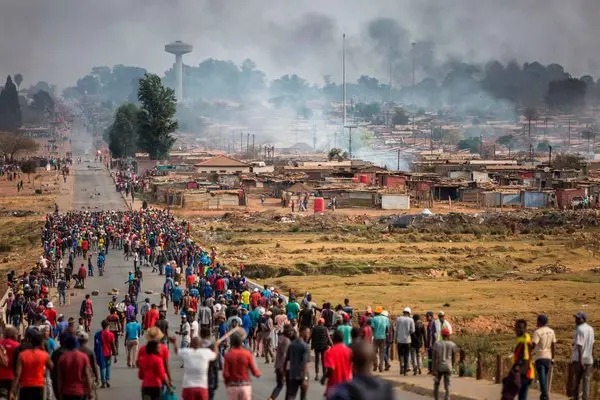
By Imraan Buccus
Across the world, the right has increasingly made xenophobia one of its central mobilising strategies. Migrants are blamed for unemployment, pressure on public services, crime, social breakdown and the failures of government. In many countries, particularly in Europe, this anti-migrant politics has become tightly entwined with Islamophobia. Migration is presented not only as an economic or administrative problem but as a threat to national culture, religious identity and civilisation itself.
South Africa’s anti-migrant politics is now following this path. The xenophobic project led by March and March and supported by other authoritarian and far-right forces is beginning to combine hostility towards migrants with hostility towards Muslims. The language has shifted from claims about migrants taking jobs and places in schools and hospitals to warnings about a Muslim “takeover”, Muslim “dominance”, an “Islamic invasion” and the introduction of Sharia law.
Jacinta Ngobese-Zuma, the leader of March and March, recently asked on social media whether South Africans were wrong to oppose Muslim organisations that shelter or provide humanitarian support to migrants displaced by xenophobic violence. She claimed that foreign Muslims were seeking “dominance” in South Africa.
Speaking to the BBC, Ngobese-Zuma said that South Africa was undergoing a “very serious religious takeover”. Muslims comprise only around 1.5% to 2% of the population. The idea that such a small minority is taking over the country is plainly absurd. But the lack of any factual basis for Ngobese-Zuma’s claim does not make it politically insignificant. Far-right politics has never depended on an accurate description of reality. It works by identifying a vulnerable group, exaggerating its power and portraying its ordinary presence in society as a coordinated threat.


Nkosikhona Ndabandaba, also known as Phakelumthakathi and closely associated with the same xenophobic mobilisation, has taken this language further. Responding to an image warning of an “Islamic invasion” and the introduction of Sharia law, he reportedly wrote: “Never ever, especially the terrorists!”
In the standard move of the right around the world, migrants, Muslims and terrorists are collapsed into one category. Muslim religious identity becomes grounds for suspicion, and the presence of foreign Muslims is portrayed as a security threat. This is a significant and alarming development in South African far-right politics. The migrant is no longer accused only of competing for jobs, using hospitals or operating small businesses. The migrant is now also presented as the carrier of a hostile religion and an agent of cultural conquest.
The expansion of the target is already visible. Xenophobic mobilisation is usually justified by saying that it is directed only against undocumented migrants. In practice, documented migrants, refugees, asylum seekers, foreign-owned businesses and South Africans who defend them are also threatened. The turn towards Islamophobia widens the target again. Muslim organisations, business owners, charities and South African Muslims who defend migrants can now be portrayed as part of the alleged takeover.
A recent post by the Pakistan South Africa Association described a visit to a church in Delmas, where it distributed food and grocery hampers to families in need. The initiative was explicitly interfaith and humanitarian. Yet some of the responses accused the association of trying to buy influence, gain control of the country or conceal predatory intentions. An ordinary act of solidarity was treated as proof of conspiracy.
The same suspicion is directed at Muslim organisations that defend migrants from unlawful arrest, exclusion or intimidation. When Muslim organisations call for due process or support migrant-owned businesses, their intervention is not treated as a constitutional position. It is presented as Muslims protecting “illegal foreigners” in pursuit of a larger religious agenda.
The argument is structured so that Muslims cannot answer it. If Muslim organisations remain silent, they can be accused of refusing to contribute to South African society. If they provide food, shelter or legal support, their assistance is described as an attempt to buy influence or impose religious dominance.



The xenophobic and Islamophobic narratives strengthen each other. Xenophobia constructs the border as being under attack. Islamophobia constructs the nation’s culture and religion as being under attack. Ethnic nationalism adds a further claim that a particular community is losing control over territory, institutions and political authority. Together, these narratives allow a movement that emerged around resentment over jobs and public services to appeal to fears about identity, religion and national survival.
Democracy requires that questions of citizenship and legal status be decided through lawful procedures rather than by political movements, mobs or social-media campaigns. It protects freedom of religion and the right of civil-society organisations to offer humanitarian and legal support.
March and March’s politics increasingly challenge these principles. It claims the authority to decide who belongs, who may enter a hospital or school, who may run a business and which organisations may assist people under threat. Its leaders present migrants as people whose rights can be suspended and Muslims as a community whose motives are inherently suspect.
The growing danger of far-right populism extends beyond migrants and Muslims. Journalists, progressive lawyers, left learning trade unionists and radical grassroots activists are all coming under increasing attack. March and March has actively sought to delegitimise constitutional and humanitarian opposition to xenophobia.
The threat to South Africa does not come from Muslims or migrants. It comes from a far-right politics that turns the poverty, institutional collapse and kleptocratic politics that drive and justify public anger into hostility towards minorities, while leaving the political and economic forces responsible for the crisis untouched.
*Dr Buccus is an academic, political analyst and editor of Al-Qalam.