Al-Qalam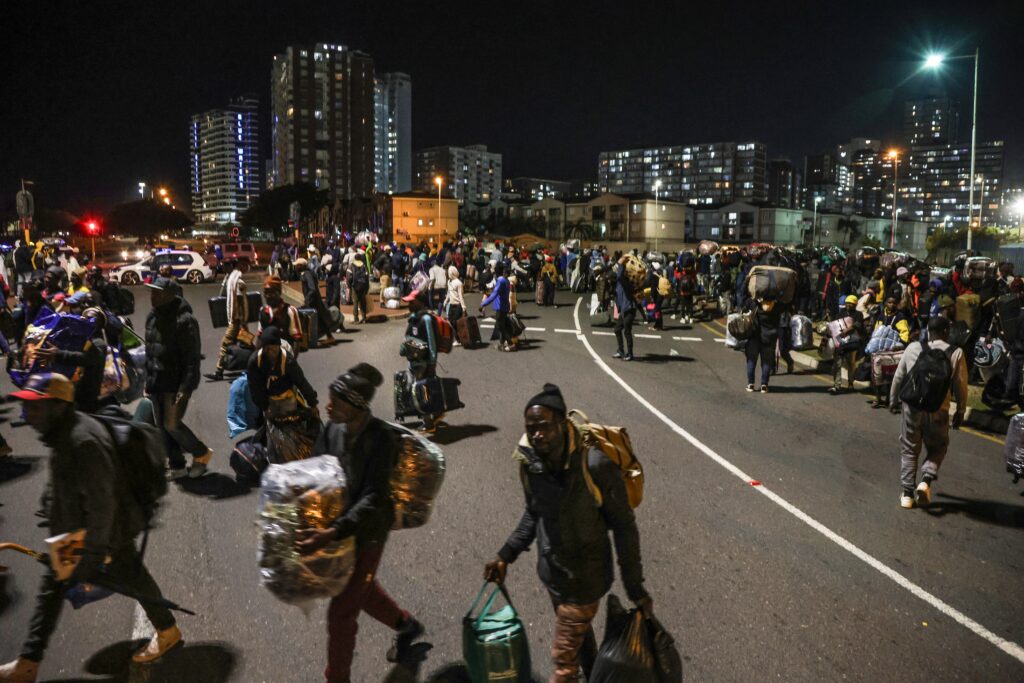
Al-Qalam goes on a walkabout at the new migrant processing centre in Durban, where thousands of Malawians have sought protection – Ismail Suder reports.
They come in waves upon waves to literally fall at the feet of their helpers at an open ground in Durban – tired, hungry and bedraggled.
Threatened with violence by vigilante mobs, the Malawians – who sought a better life in South Africa – are now fleeing with only the clothes on their backs.
“It’s a bottomless pit,” the Home Affairs Kwa-Zulu-Natal manager, Cyril Mncwabe, reportedly said.
And just opposite the fenced ground, thousands more are gathering in the street – an even mix of Muslims and Christians – who are waiting to be allowed in. It’s a dilemma for the authorities who are stretched to the limit. Dozens of buses have already departed for Malawi, but it’s no way nearly enough to move over 10 000 migrants back to their homeland.
When thousands of the fleeing Malawians first gathered in a park in Sherwood, Durban, recently, several charitable Muslim organisations, including Gift of the Givers, immediately stepped into provide sustenance to the hungry men, women and children. After an uproar on social media, which highlighted the filth and squalor they were living in, the Municipality eventually moved the Malawians to the old Drive-In site in the city, a large expanse of ground barricaded by a solid fence.


Reporters are barred from entering the highly fortified grounds, but after some tough negotiations with a tough-looking security team at the main gate, Al-Qalam was the only media allowed to enter, thanks to the timely intervention of Pastor George Mzenda, an associate from the Malawian Embassy who is overseeing the welfare of his countrymen.
The place looked like a concentration camp, perhaps best described as organised chaos. Long lines of men – 200m long – waited in a queue to be registered by both the South African and Malawian authorities for the long two-three-day bus journey home – an arduous 2250km trip to the city of Blantyre.
“We are tired, we just want to go home,” said Omar, who stood in line with his worn-out passport to be registered for the bus trip back to Malawi. He admitted to Al-Qalam that he illegally slipped into South Africa and made his way to Durban, earning about R3000 per month as a shop assistant. Asked what method he used to slip through the SA border, Omar refused to say, except to smile sheepishly.
Another young man, Ismail, said he was thankful to be behind the security fence, knowing vigilante mobs from the March and March movements won’t be able to penetrate the heavily guarded refuge centre to attack them.
In Pietermaritzburg, vigilantes have killed five Malawians. When news broke about the killings, the Malawian community – both documented and undocumented – fled to congregate at Sherwood Park.
Mohammed (27) said last week, a mob came to his room that he rented in Overport and demanded that he leave the premises immediately. Terrified, he fled and hid in a thick bush the entire night. When he cautiously returned to his place the next day, it was ransacked and everything was stolen, including his bed.
In a walkabout through the grounds, Al-Qalam spotted a mobile clinic treating people with a variety of ailments, mainly flu symptoms. So far, 15 babies were born within a week, Pastor Mzenda tells me. “I’m no doctor, but I think the babies were born prematurely due to stress on the mothers. One baby has sadly died,” he added.



In another tent, an Islamic charity group was dishing out steaming acknee from a large degh and a few steps away, brother Farouk Mahomed of Rainbow Food Relief, was stirring a large pot of tea for the migrants. Next to the large food tent, a little tented area served as a mussalah for five daily salaah. A young man was busy reading the Quran, oblivious of my presence.
At Asr, a muezzin was calling out the Azaan in a melodious voice that wafted across the camp. Dozens of Muezzins across Kwa-Zulu-Natal have since joined the queue to return home. In fear of their lives, many tearfully bid farewell to their masjids to save themselves from being lynched on June 30 when the March and March vigilantes have threatened to hunt them down.
Asked what he would do for a living when he returns to Malawi, Dawood (29) replied sadly: “There is no work there …but it’s better for me to eat grass and die of starvation in Malawi than to be killed and buried in an unknown grave in South Africa.”