Al-Qalam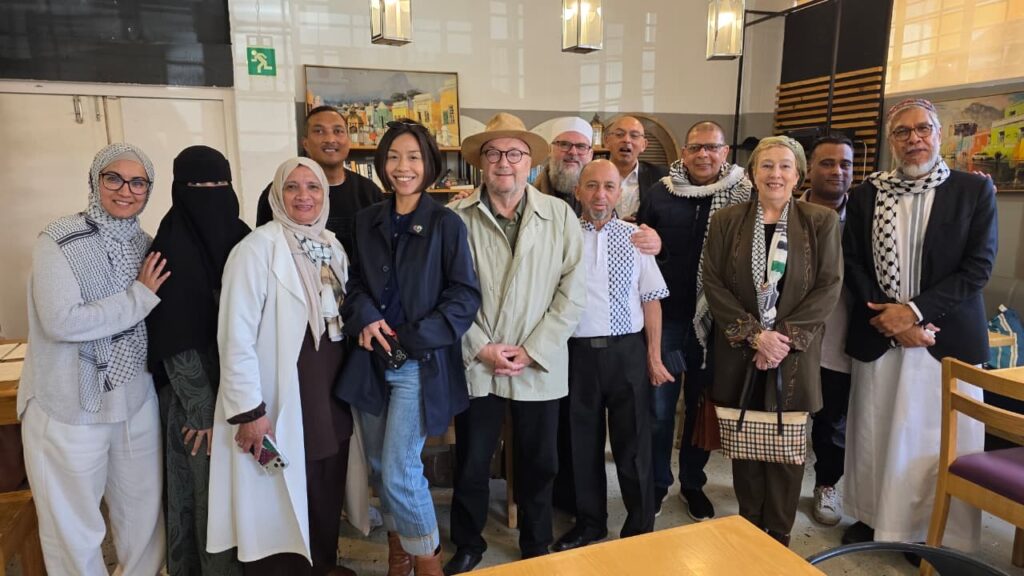
British journalist Yvonne Ridley and British politician George Galloway, meeting with Al-Quds Foundation SA Photo credit: Ahmed Meshtawy
British journalist Yvonne Ridley toured SA recently along with George Galloway. Al-Qalam correspondent Fazlin Fransman-Taliep caught up with her.
“God is not an estate agent,” says celebrated journalist and author Yvonne Ridley.
Yvonne Ridley has a gift for the sentence that refuses to leave the room. In our interview, the British journalist moved from the story of a runaway donkey in Afghanistan to the moral responsibilities of Muslims towards Palestine, wielding humour and indignation with equal precision.
The remark came as she praised Jewish opponents of Zionism who reject religious justifications for territorial claims. She speaks with admiration of their dissent, and with fury at what is being done in their name beneath an Israeli flag that, in her words, “has now become a butcher’s apron”.
But before the political arguments came the donkey.
In 2001, reporting for the Sunday Express, Ridley entered Afghanistan beneath a blue burqa. She likened its anonymity to “putting on Harry Potter’s invisibility cloak”. Her cover unravelled when the animal carrying her towards the Pakistani border bolted, exposing her camera to a Taliban soldier.
“I was done for by a rogue donkey.”


Having surrendered her camera, she closed her eyes and waited to be shot. She might subsequently have escaped. Instead, seeing her local guides detained and surrounded by an angry crowd, she turned back.
“And I realised I couldn’t leave them behind.”
She imagined her guides would admire her return. Instead, she recalled, they looked as though she had made their predicament considerably worse. The Taliban now had a British journalist in their custody.
For the next 11 days, she expected to be killed. She describes herself as “the prisoner from hell”, swearing, spitting and throwing things during interrogations.
“You don’t kiss the hand that slaps you.”
Their restraint confounded her expectations. Recalling the brutality she had anticipated, she delivered an incredulous question: “Why aren’t you living up to the job description?”
Her subsequent interviews with former Guantánamo Bay detainees sharpened that contrast. Hearing their accounts, she considered herself fortunate to have been held by the Taliban rather than the Americans. Her verdict was deliberately barbed. “Thank God I was captured by the most evil, brutal regime in the world and not by the Americans.”
By her account, the Taliban had treated her more humanely than the Americans had treated the Guantánamo detainees she interviewed.
“When I was released, I don’t know who was happiest, them or me.”
A religious cleric had invited her to embrace Islam during captivity. Ridley declined to make such a decision as a prisoner, but promised to study Islam and read the Qur’an if released.
“If you give your word, your word is your bond.”
She kept that promise without expecting it to change her faith. “I wasn’t looking for a religion. I was a practising Christian.”



A former Sunday school teacher, she found familiar figures in the Qur’an. What moved her was its account of women’s spiritual equality and its demand for justice, including towards one’s enemies.
“The theme of justice really swept me away,” she tells Al-Qalam.
Her solidarity with Palestinians, however, preceded her conversion by decades.
At 13, she recalled, a Palestinian woman asked her to sign a petition. Ridley initially refused. Television coverage had taught her to associate Palestinians with hijacking and terrorism. The woman explained the history of dispossession.
Ridley imagined her own family being forced from their home, strangers wearing her clothes and eating their food.
“And I was shocked that I hadn’t understood this from the media.”
Her conversion brought an additional responsibility – protecting Masjid Al-Aqsa. She urged religious scholars to prepare their communities spiritually for that obligation.
“We don’t need weapons,” she said, envisaging collective Muslim mobilisation.
For Ridley, solidarity demands a response to suffering. She described seeing images of children mourning their father, a journalist killed in an Israeli strike.
“Children shouldn’t have to see that sort of thing.”
The sentence carries none of her usual verbal fireworks. It needs none.
She urged people to stand with Palestinians through peaceful protest. In Afghanistan, she had turned back rather than leave her guides to face danger alone. Now, she asks others to act on the same conviction: that we cannot walk away from people whose lives are at risk.
The question she imagines facing Muslims on the Day of Judgement is characteristically direct: “What did you do to protect Masjid Al-Aqsa?”