Al-Qalam
The elections exposed changing political loyalties in Muslim communities, writes Fazlin Fransman Taliep
The Democratic Alliance won Cape Town. But beneath that victory, in the voting districts of Rylands, Surrey Estate, Rondebosch East and Bo-Kaap, a different political story was unfolding. One that cannot be understood through ward victories alone, and one that raises questions about the influence of Palestine, religious conscience and the Muslim vote.
The November 4 local government elections offered the first electoral test following a fatwa issued by the Muslim Judicial Council (SA), which placed the question of political support within an explicit Islamic moral framework. The results do not establish how many voters acted on that ruling. They do, however, reveal significant movement in communities where the relationship between political allegiance and the Palestinian cause has become increasingly contested.
Across Cape Town, the DA retained its majority with 56.4% of the combined municipal vote, down from 58.3% in 2021. Al Jama-ah increased its share from 1.3% to 2.4%, doubling its council representation from three to six seats.
The citywide figures tell only part of the story. In Ward 46, encompassing Rylands, Gatesville and Surrey Estate, the DA retained the ward with 37.3%, a considerable decline from approximately 52% in 2021. Al Jama-ah finished second with 26.6%. More revealingly, Al Jama-ah won individual voting districts at Duinefontein Muslim Association, Rylands Primary School and Portavue Primary School.
In Ward 60, encompassing Rondebosch East and parts of Lansdowne, the DA secured 40.8%, compared with approximately 56% in 2021. Al Jama-ah’s ward support rose from around 7% to 23.4%. At the Rondebosch East Islamic Centre voting district, the DA finished just three votes ahead.
In Bo-Kaap, Al Jama-ah topped the ward ballot at Schotsche Kloof Primary School, securing 38.7%. The wider ward remained overwhelmingly DA.
These results expose a fundamental limitation in how elections are routinely interpreted. A party can retain a ward while experiencing a substantial erosion of support within particular communities. The final colour of an electoral map often conceals more than it reveals.


There is, however, an important demographic distinction. These neighbourhoods are not exclusively Muslim, and Muslim voters support several political parties. Al Jama-ah cannot be regarded as a complete measure of Muslim political preference. Its gains nevertheless offer a measurable indication of changing allegiances in communities with longstanding Muslim populations.
Eight days before the election, the MJC’s Fatwa Department, under Mufti Yaaseen Abass, issued a ruling addressing the permissibility of knowingly supporting political entities that endorse, justify or facilitate the unlawful killing of human beings.
Grounded in Qur’anic principles concerning the sanctity of life and the prohibition against cooperation in wrongdoing, the ruling held that knowingly empowering such entities, including through voting, campaigning or financial support, constitutes prohibited cooperation.
The fatwa named no political party. Nor did it direct Muslims towards a particular electoral alternative. It established a religious principle through which individuals could assess political responsibility.
Its significance lies partly in its timing, but more profoundly in the question it placed before the electorate: can political support be separated from moral responsibility for the actions a party endorses?
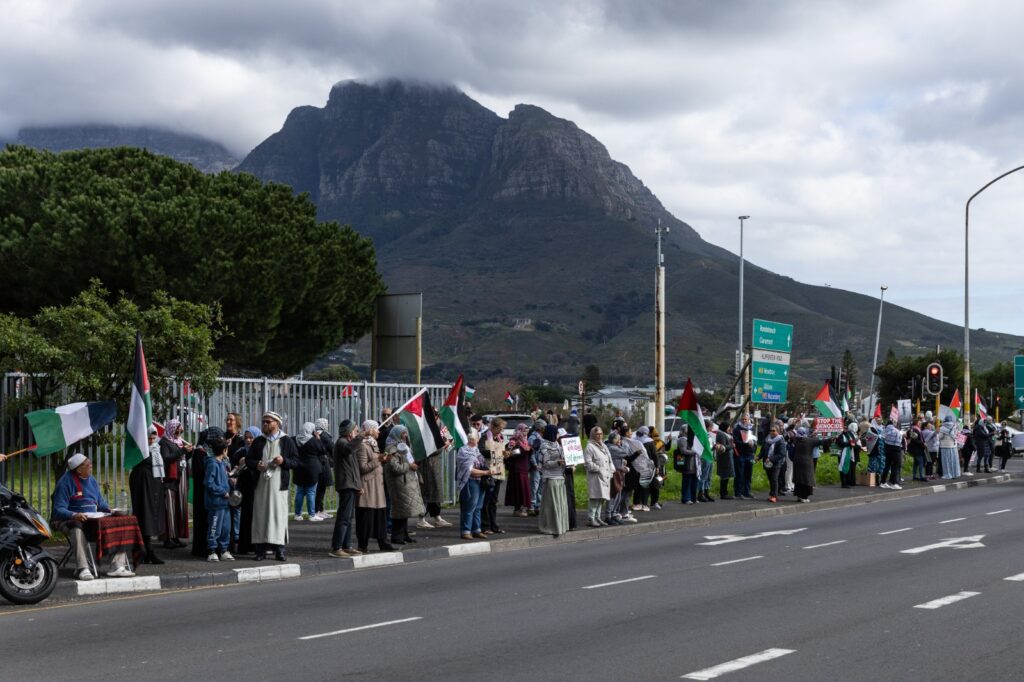
That question had occupied Muslim public discourse long before the fatwa. Since October 2023, Palestine has increasingly informed political debate within South Africa’s Muslim communities. The positions taken by parties on Israel and Gaza have become matters of scrutiny extending well beyond foreign policy. The fatwa therefore entered an existing conversation rather than initiating one.
The electoral response also challenges the narrative advanced by Patriotic Alliance leader Gayton McKenzie, who questioned why Muslims critical of parties they described as Zionist were supposedly continuing to support the DA. He specifically cited Rylands as an example. Yet Rylands and neighbouring Surrey Estate were precisely where Al Jama-ah recorded several voting-district victories. Moreover, McKenzie’s argument assumed that votes cast in Muslim-dense suburbs could automatically be attributed to Muslim voters, an inference the data cannot sustain.
Cape Town Mayor Geordin Hill-Lewis offered a more revealing acknowledgement. Asked whether Palestine had contributed to declining DA support in Muslim communities, he conceded that campaigning by religious bodies and political parties on the issue had hurt the DA. He also cited local concerns, including crime and service delivery, and committed to renewed efforts to “get those voters back”.



Beyond Cape Town, the picture is neither uniform nor insignificant. In Johannesburg’s Lenasia, Al Jama-ah won Wards 9 and 10, securing 35.4% and 33.2% respectively. The party already had an established electoral presence in Lenasia, making it important to distinguish longstanding support from new gains. In Ward 10, however, its ward share rose from approximately 21.1% in 2021, suggesting an expanding political constituency, subject to changes in ward boundaries.
Durban presents a more restrained picture. In eThekwini’s Ward 31, which includes parts of Overport, the DA’s support declined from 50.9% to 45.3%, while Al Jama-ah received 6.9%. The party secured one proportional representation seat across the municipality. Unlike parts of Cape Town, the available figures do not establish a comparable concentration of electoral change. A national conclusion about Muslim voting behaviour would require much more detailed voting-district analysis.
The central question remains how much of the observed change can be attributed to the fatwa itself. Elections cannot isolate religious guidance from longstanding political grievances, international events, candidate preferences or local conditions. The ballot establishes what happened, but not every reason why.
Yet the results invite reflection on something beyond the fortunes of individual parties.
For a community in which solidarity with Palestine has long been expressed through protest, prayer, humanitarian assistance and public advocacy, the election raises the question of whether those convictions are increasingly finding expression in political choices.
The implications extend beyond any single election. They concern the relationship between religious guidance and democratic citizenship, the accountability voters expect from political parties, and whether political loyalties once considered secure are becoming more conditional.