Al-Qalam
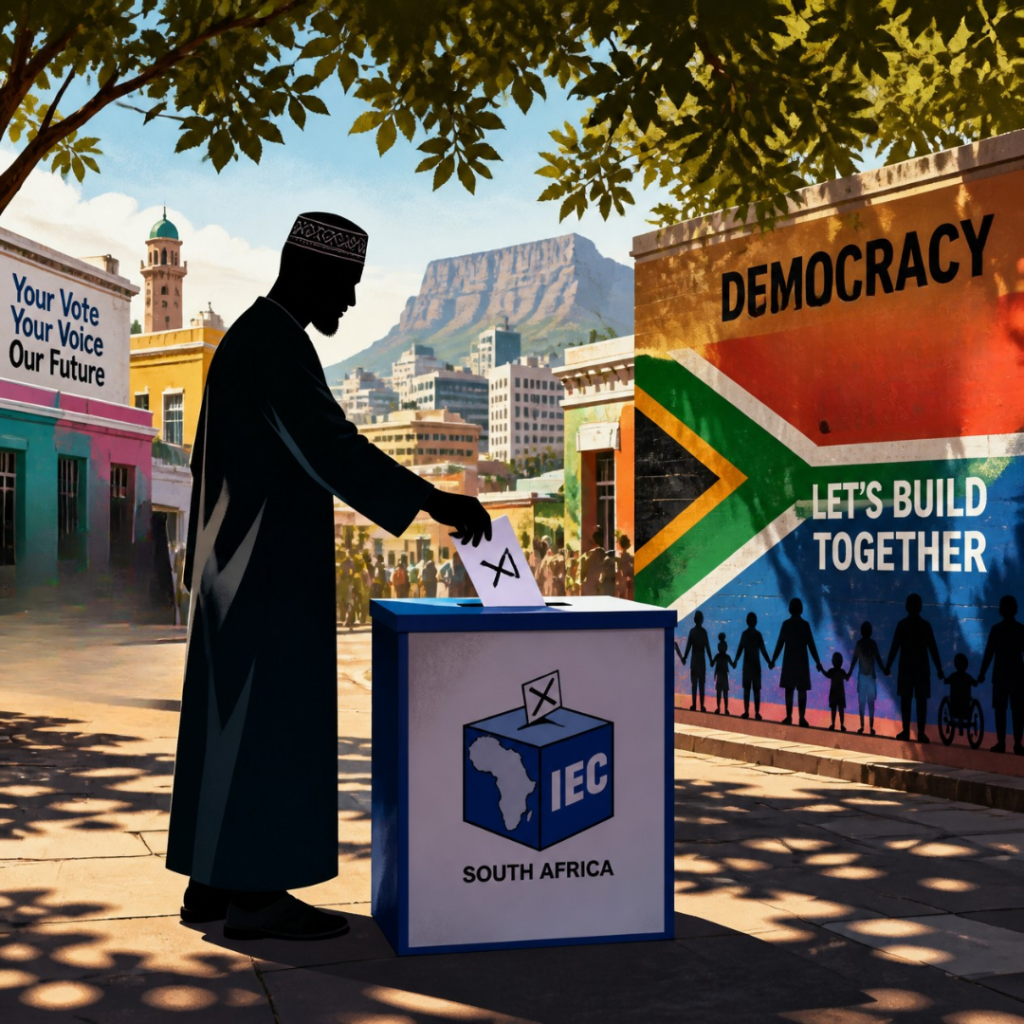
(This image contains Ai-generated content)
By Aslam Fataar
South Africa’s local government elections on 4 November 2026 present voters with an ethical responsibility: deciding which political parties and ward candidates deserve their support. Beyond promises of efficient service delivery, these choices require consideration of justice, political integrity, human dignity, and the needs of vulnerable communities.
Three Islamic commitments offer guidance: dhikr that becomes ethical action, solidarity beyond our own communities, and responsible citizenship grounded in knowledge. Together, they provide a framework for voting with conscience.
Dhikr/Remembrance that moves into the streets
Dhikr extends beyond reciting Allah’s names, sending salawat and inward reflection. The Qur’an reminds us that hearts find tranquillity in Allah’s remembrance (13:28). For Imam al-Ghazali, remembrance must shape character and become visible in ethical conduct.
Active dhikr becomes palpable when neighbours feed hungry families, welcome refugees, protect women facing violence and mentor young people. It continues when residents challenge unfair budgets, organise around broken streetlights and participate in ward meetings. Remembrance becomes a practice of noticing, learning and acting. It also informs how we vote.


Solidarity beyond our own community
The Qur’an commands cooperation in righteousness, not wrongdoing and aggression (5:2). This principle of ta‘awun, alongside ukhuwwa (brotherhood and sisterhood), makes solidarity a public responsibility. Charity matters, but cannot alone overcome the conditions producing poverty and exclusion.
Political judgment must therefore consider housing, unemployment, public safety and services, alongside parties’ treatment of women, refugees and marginalised communities.
The Qur’an praises those who welcomed migrants despite their own hardship (59:9). The Prophet Muhammad’s (s) community in Madinah exemplified hospitality towards displaced people. Populist political movements that exploit racial divisions, portray refugees as threatening outsiders or mobilise xenophobic hostility must be examined against this Prophetic ethic. Addressing local hardship must never require dehumanising strangers.
Citizenship as a public trust
Fiqh al-muwatana, the contemporary jurisprudence of citizenship, connects participation to amana (trust), ‘adl (justice), shura (consultation) and maslaha (public welfare).
The Qur’an commands believers to honour trusts and judge justly (4:58), while commending consultation (42:38). These principles provide an ethical foundation for informed voting and accountable governance.
Competent municipal administration matters, especially for working-class households. Reliable services and honest procurement are essential. Yet efficiency must be considered alongside justice, equitable resource distribution and human dignity.
Why efficiency cannot displace justice
In a September 2025 Mail & Guardian article, Imraan Buccus and I criticised Helen Zille’s response to the genocide and mass killing of Palestinians in Gaza. We argued that her emphasis on administrative efficiency deflected attention from the moral question of political complicity in Israel’s actions. Functioning traffic lights and reliable municipal services cannot provide moral cover for political support of those responsible for atrocities.
Good governance cannot be reduced to administrative performance while genocide, oppression and human dignity become secondary considerations. Justice is indispensable to legitimate governance. No administrative achievement can compensate for complicity in genocide or oppression.
My central voting principle follows: electoral support carries moral responsibilities, including the obligation to consider whether it implicates us in grave injustice. Parties’ positions on genocide, unlawful killing and oppression therefore warrant serious scrutiny, alongside their municipal records. The same scrutiny applies to racial hatred, xenophobia and exclusion. Competence cannot erase fundamental ethical questions.



Putting conscience into practice at the ballot box
Voting with conscience requires examining evidence rather than relying on political slogans. Four questions can guide the decision.
First, ethical responsibility: What have parties actually said and done concerning genocide, oppression, racial division and refugees? Examine statements, policies, alliances and voting records, distinguishing documented conduct from allegations.
Second, governing performance: Have parties delivered water, sanitation, housing support and safe public spaces? Have they addressed corruption and distributed resources fairly, especially in poorer neighbourhoods?
Third, ward representation: Is the candidate accessible, trustworthy and active locally? Have they listened to residents, understood community problems and honoured commitments?
Fourth, verification: The Qur’an instructs believers to investigate reports before acting in ignorance and causing harm (49:6). This principle of tabayyun requires checking manifestos, credible reporting and candidates’ records rather than accepting WhatsApp rumours or inherited party loyalties.
These questions bring ethical commitments, political conduct, municipal performance and local accountability into a considered electoral judgment.
Beyond election day
Citizenship continues through ward meetings, budget scrutiny, service-delivery monitoring and collective action against exclusion. Communities should recognise effective governance while holding representatives accountable.
Dhikr, solidarity and voting belong together when remembrance cultivates conscience, conscience informs judgment, and judgment sustains public responsibility. Our commitment to justice must shape both our choices at the ballot box and the communities we build afterwards.
*Professor Aslam Fataar is a Research and Development Professor in Higher Education Transformation, Department of Education Policy Studies, Stellenbosch University. This article is based on a khutbah delivered in Cravenby, Cape Town, on 30 October 2026