Al-Qalam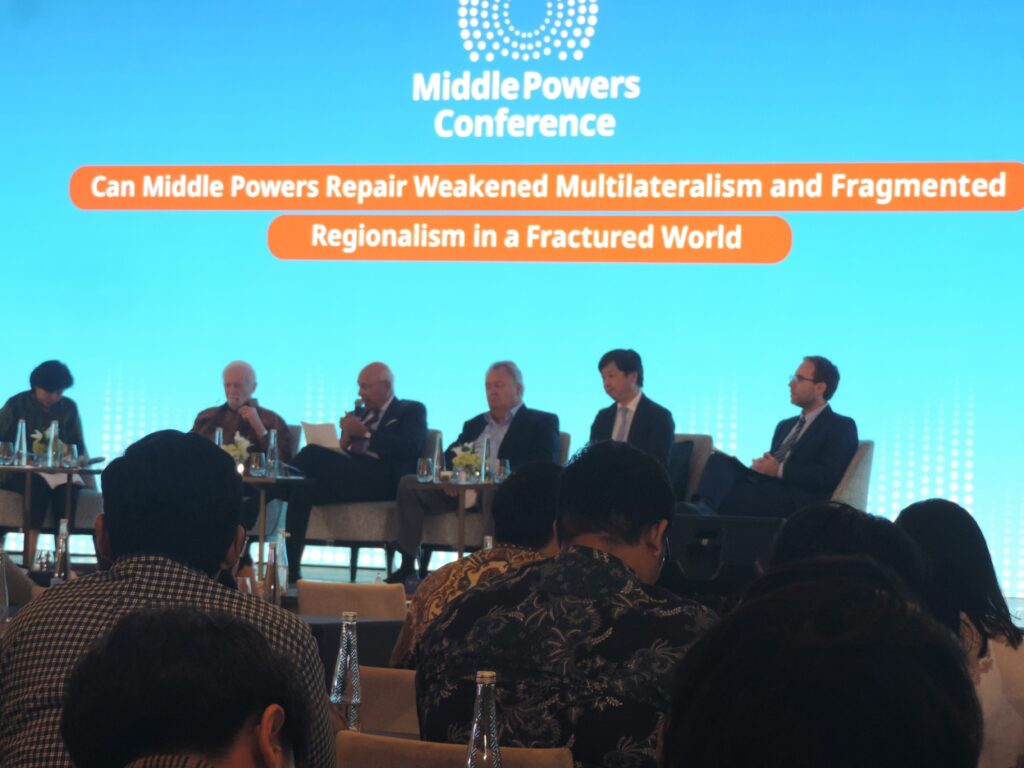
By Ebrahim Rasool [Former Ambassador to the USA]
Indonesia recently hosted foreign policy practitioners from middle powers – countries with significant regional influence, catalysts for multi-lateral reach, and while having some military and economic leverage, they hone a diplomatic ability to secure stability and development. Jakarta gathered two such categories (traditional north/western and emergent middle powers from the Global South) at a critical moment in the history of the world in which the United States, and its regional ally in the Middle East, Israel, are conducting a war of choice against Iran, with negative global reverberations in supply chains, inflation, and security.
But Iran is proving more resilient than expected, and survival itself is victory. The United States, however, no longer appears impervious to resistance, but while it is vulnerable as a superpower, it still retains sufficient superpowers to prevail. Middle powers, traditional and emergent, are now forced to consider what a post-American world would look like. In the interim, they have to cope with an America that is an incoherent, rogue, and punitive superpower, bereft of strategic vision.
Among middle powers, South Africa is regarded as significant, despite our own challenges and self-doubt: it is regarded as credible for its convening of BRICS and the G20, courageous for charging Israel with genocide; garnered great sympathy for bearing the brunt of Trump’s lies about a ‘white genocide’and his punitive measures; and in turn, there are great expectations about SA’s role in strategizing a way out of the current impasse. My input articulated a few key themes, culminating in a set of five scenarios on offer for a world needing to respond to an unhinged superpower dealing with its eclipse.
The foundational theme is to recognise a transition from the unilateralism of a dominant United States that took the world through 30 years of wars, running up a deficit of 39 trillion US dollars and creating a war-weary US citizenry. Now we are witnessing the emergence of multipolarity – competing poles in the world: some regional, like ASEAN; some a collection of emergent economies, like BRICS; and some tentatively defensive, like the EU. But none, yet, are in any position to challenge the dominance of the USA.


The corollary theme is that the Middle East, as the theatre of conflict, demonstrates the erosion of consent. The dominant consensus that existed, of Israel’s impunity, following the Jewish Holocaust, is increasingly coming to an end. In the United States, where most citizens are denying Israel such a free pass – US arms fuel unjust aggression and the genocide of Palestinians. This has severe implications for whether Trump will be able to carry through the Netanyahu playbook of destroying Iran. Already, Trump is hesitant as Iran’s resilience creates discontent at home and among allies, and this is translating into a war effort that is regarded as pointless and operationally inept, all at the behest of Israel.
Yet, while the US may appear to be erratic, declining, and run by a narcissist, we must not underestimate the United States. The emerging multipolarity that can assert itself against the USA has not yet been established. Despite disenchantment with and fragmentation from the USA, few can act decisively. Therefore, the world requires a set of strategies to respond smartly and collectively to the USA. What then are the scenarios for such a strategic response to the United States of America by middle powers? The scenarios posited for middle power relations with the USA currently are five.
The Ideal Scenario is one of Mutuality and Reciprocity and is premised on cooperation and exchange based on mutual need, in which the USA walks on two legs – soft and hard power – and therefore invests in other countries a combination of exchanges of markets for trade, investments in capacity, and development aid against vulnerability, to ensure mutual development and security, with limited migration to the north. This is obviously the scenario spurned by Trump in his amputation of the leg of soft power, and for the immediate future is highly unlikely.
Trump’s preferred scenario is the Scenario of Surrender. Surrender Greenland, the Panama Canal, national sovereignty, energy, critical minerals, and rare earth elements, and in the case of Iran and Palestine, sovereignty, land, resources, and dignity. Venezuela is the template, and SA is on the menu. For Middle Powers, this scenario is not tolerable.
The instinctive, responsive scenario is one of Retaliation against the USA. Only China comes close to having the wherewithal for retaliation, and even then, not in a sustained and sustainable way. When China withheld rare earth elements, like Gallium, in response to 250% tariffs by the USA, it forced Trump to go to Seoul and negotiate a reprieve. Iran is proving the workability of such a scenario – only because it has nothing to lose. But for everyone else, this will remain a difficult scenario while no multilateral capacity exists.



These 3 scenarios are not possible or probable in the current context, which therefore compels the search for intermediate scenarios.
Therefore, the fourth lies between Mutuality and Surrender – the Scenario of Appeasement. It means conceding to pacify an aggressive party to prevent a conflict by satisfying its demands. This was the word used to describe the initial approach to Hitler, and various countries are trying this with Trump, offering jets, Trump Towers, deals for his children and investments in the USA. Alternatively, such propitiation can often take the form of smiling through blatant lies and ad hominem attacks. This is currently the most likely scenario in relation to the USA.
The fifth scenario lies between Mutuality and Retaliation and can be called a Scenario of Contingency. It is a soft retaliation in which insurance policies are taken out to mitigate the shocks of a capricious power. This is sophisticated, necessarily so, and involves a series of mitigation measures like finding alternative markets for tariffed goods, alternative sources of investment and development aid, and basically ensuring that your eggs are not all in one basket. Simultaneously, this must be accompanied by tying your wagon to other multi-lateral engines and ensuring that the world is building a collective insurance against unilateral actions.
In working through these scenarios and finding one, or a combination of a few, the middle powers must divine whether the scenario is a holding operation – to see out the Trump years – before returning to ‘normal’ or whether this is permanent – on the assumption that the USA is fundamentally altered and, once it tastes the power of tariffs and bellicosity, it will not return to the status quo ante, even though that was itself aggressive and invasive. However, the erosion of trust in the USA – whether by NATO or the Global South – is such that there must be an unstoppable momentum to transform the emerging multi-polarity into an effective multi-lateralism that can withstand an untethered superpower.