Al-Qalam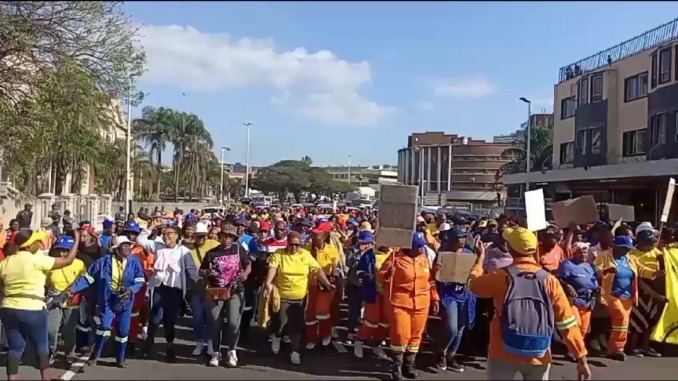
By Imraan Buccus
In the media, South Africa’s municipal crisis is routinely explained as a failure of leadership. The explanation centres around corruption, gangsterism and incompetence, and the language is overwhelmingly that of moralism.
There is truth in this. There are councilors who loot, officials who cannot do their jobs, considerable penetration by organised crime and political actors who treat public office as nothing but a route to private enrichment via public funds. All this must be noted and directly confronted.
But this account does not go far enough. Municipal collapse cannot be understood as only a failure of leadership or ethics. It also has to be located in deeper structural dynamics that shape what local government is, what it does, and what it is able to sustain. Without confronting these dynamics, calls for clean governance will remain necessary but insufficient.
The first of these dynamics is the political economy of patronage. Local government has become a key site for the distribution of resources in a society marked by mass unemployment and deep inequality. Municipal office offers not only a salary, but access to tenders, influence over hiring, and the ability to distribute opportunities.
In a context where millions of people are locked out of formal work, this power is intensely contested. The struggle for office is not just about politics. It is about survival. This is why, in some parts of the country, such as Durban, competition for positions as councillors results in regular assassinations.
Under these conditions, factionalism is not an aberration. It is produced by the system itself. Loyalty is organised through networks of distribution rather than shared political programmes. Decisions are shaped by the need to hold coalitions together. At the same time, municipalities become arenas of struggle between competing patronage networks, with the result that administrative capacity is subordinated to political survival.


The second dynamic is the depoliticisation of the public. With the notable exception of Abahlali baseMjondolo, the mass movements of the 1980s are long gone and for many people participation in governance does not extend beyond voting every few years. Even more people do not bother to vote. When a space is made for civil society, it is usually for NGOs rather than membership-based organisation. In these spaces, the technocratic language of governance has displaced the language of politics. Questions of power and distribution are recast as matters of management.
All this weakens the capacity of ordinary people to act collectively in defence of the public interest. It also creates space for anger to be mobilised in destructive ways. Where there are no effective democratic channels, resentment can be redirected in toxic ways by toxic actors.
We see this clearly in growing attempts at xenophobic mobilisation. It presents itself as a defence of local resources. In reality, it expresses a politics that cannot confront the structural causes of deprivation but happily scapegoats migrants instead.
The third dynamic is the erosion of collective institutions. Trade unions, civic organisations and other forms of collective life have historically played a central role in mediating between the state and society. They have organised demands, built solidarity and exercised pressure from below.
Today, many of these institutions are weakened. Union density has declined. Some unions are deeply corrupt and authoritarian, and a senior union leader is wholly captured by a donor. Civic structures are often fragmented or absent and there has been a systemic substitution of NGOs for membership-based organisations. Where people have tried to organise, they have, as with Abahlali baseMjondolo and a number of communities dealing with mining issues, faced serious repression, including assassinations.
The consequences of all this are serious. There are fewer mechanisms to discipline political elites and fewer spaces in which collective demands can be formed. The capacity to defend the public as a shared good is weakened, and politics becomes more individualised, more volatile, and more open to manipulation.
These dynamics reinforce each other. Patronage corrodes administration, depoliticisation weakens accountability and the erosion of collective institutions removes the social foundations on which democratic governance depends.
To be clear, none of this means that leadership and ethics do not matter. They do. There are municipalities that function better than others, and leadership is part of the explanation. But even the best leadership operates within structural constraints that cannot be overcome by integrity alone. Corrupt people and practices must be dealt with as an urgent priority, but the structural issues need to be confronted too.



This means addressing the political economy of patronage. It requires tightening procurement, professionalising administration and limiting opportunities for rent-seeking. It also requires confronting the wider reality of unemployment and inequality that drives competition for access to the state. If we do not treat mass structural unemployment as a crisis, we will never resolve our political and social problems.
It is also necessary to repoliticise the public by rebuilding forms of participation that enable people to act collectively. In much of the country, spaces like ward committees have long been captured by toxic actors but it is possible to build outside these spaces. The public can only be effectively politicised from within, and this requires a new generation of activists like those that emerged in the 1970s and 1980s, including university-trained activists willing to work with ordinary people on the basis of mutual respect.
We also need to address the crisis in the trade union movement. Some unions have passed the point of no return with endemic corruption, death threats being used to contain dissent and the buying of internal elections. The unions and union leaders that sustain integrity – such as the General Industries Workers Union of South Africa (GIWUSA) and Zwelinzima Vavi – need to be supported and new credible unions built from the ground up. As with rebuilding community organising, this requires a new generation of committed activists, who can do the work that people like Jabu Ndlovu, Moses Mayekiso and many others did in the past. This also requires the commitment of university-trained activists who can do the kind of work that people like David Hemson, Neil Aggett and Jay Naidoo did in the 1970s and 1980s.
In a situation of mass unemployment, it is also imperative to connect the organised working class to the unemployed and the poor. It is an uncomfortable reality that many in the union movement look down on the poor and share the prejudices of the middle classes. Across the Global South, the urban poor have become key political actors and the fetish of the worker as the only legitimate political actor needs to be put aside.
The problems we face are ethical, but they are also political and – contrary to the assumptions of the media – moralism is not a sufficient response.
*Dr Buccus is editor of Al-Qalam and research fellow at the University of Johannesburg’s Institute for Advanced Study (JIAS).