Al-Qalam
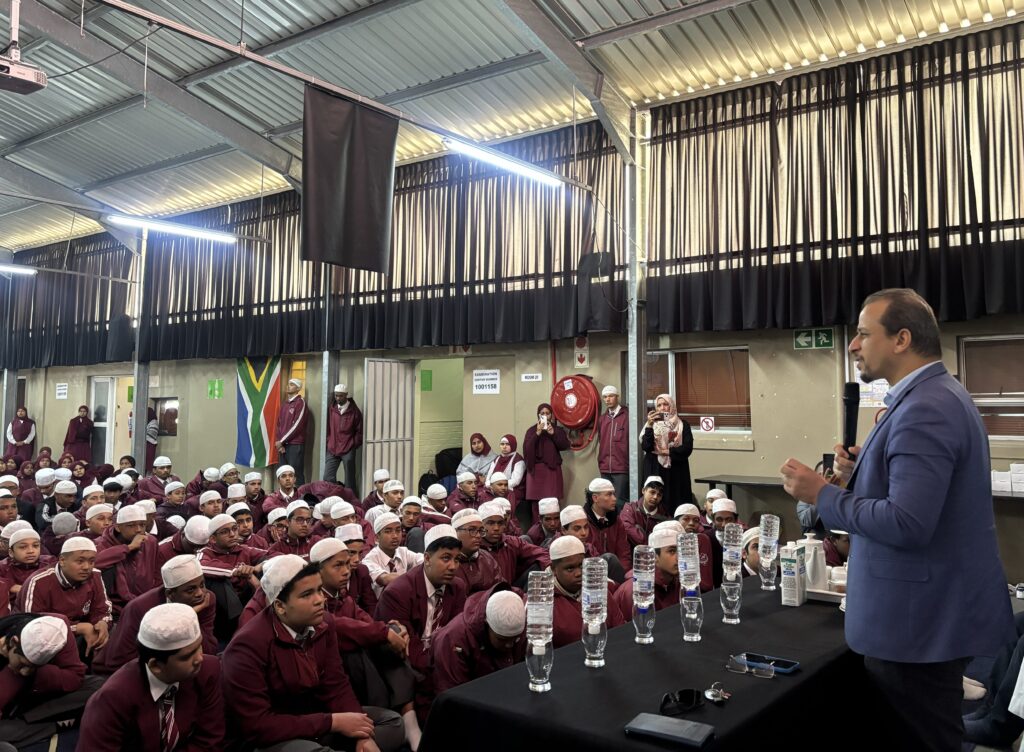
Dr Khalid Al-Awaisi addresses students at Al Azhar High School
By Fazlin Fransman Taliep
Visiting Palestinian scholar Dr Khalid Al-Awaisi has asked an uncomfortable “How could the ummah that professes such conviction in its faith witness a genocide in Gaza and remain so powerless to stop it?”
In an interview during his visit to Cape Town, Al-Awaisi asked a more uncomfortable question of the Muslim ummah: how could a community that professes such conviction in its faith witness such suffering and remain so powerless to stop it?
“Our iman is theoretical,” he said.
Throughout the interview, Al-Awaisi returned to the demands of solidarity: what Muslims were prepared to sacrifice, and how consistently they were willing to act. Al-Awaisi questioned the comfort of believing that prayer, a donation and a boycott had exhausted every available responsibility.
He recalled warning his aunt against returning to northern Gaza. She laughed and told him they were waiting their turn for martyrdom. Her response made him question the distance between her trust in Allah under bombardment and the faith professed by Muslims living in safety.
Faith and Palestine had been intertwined in his own life since childhood. Growing up in Al-Khalil, also known as Hebron, he accompanied his father to Al-Aqsa, where the elder Al-Awaisi taught university students. His father preferred to hold classes inside the masjid rather than in the lecture halls beneath it. Long before Al-Awaisi studied the Holy Land, he knew it through those visits with his father.


During the first intifada, Al-Awaisi recalled soldiers firing at his primary school while children played during break time. Curfews restricted daily life, and Palestinians confronted the occupying army with stones. His memories place October 7, 2023, within a much longer history of occupation – one he had experienced as a child.
His father was later expelled to southern Lebanon alongside hundreds of academics and activists, he said. The family was subsequently forced out of Palestine. Al-Awaisi has never returned to Al-Khalil. A later visit to Al-Aqsa was possible with a foreign passport.
That experience informs his scholarship in Bayt al-Maqdis studies, which examines the Holy Land through its history, religious traditions and significance for Muslims. It also informs his impatience with language that makes Palestinians solely responsible for defending it.
“Al-Aqsa is not a Palestinian masjid,” he said.
Al-Awaisi argued that anyone witnessing Palestinian suffering has a responsibility to help. For Muslims, that duty is also rooted in faith: Al-Aqsa is sacred to the entire ummah, yet Palestinians have been left to bear the cost of defending it. He questioned how Muslims elsewhere could claim a bond with the masjid while leaving Palestinians to face such suffering alone.
To illustrate that shared responsibility, he asks Muslims to imagine soldiers entering the sanctuary in Makkah and attacking worshippers around the Ka‘bah.
“Would Muslims regard that as a matter for Saudis alone?”
An attack on the Ka‘bah would concern the entire ummah, he argued. Defending Al-Aqsa should carry the same sense of collective responsibility.
Al-Awaisi reserved some of his sharpest criticism for Muslim governments, describing their failure to protect the people of Gaza as a source of shame for the entire ummah.
For South Africans, there was a particular connection. Al-Awaisi recalled learning the power of boycotts through refusing South African goods while living in Britain during apartheid. He praised South Africa’s pursuit of accountability through international courts and the Muslim community’s longstanding attachment to Al-Aqsa.



His praise was also a call to deepen that commitment. He urged people to give beyond the spare change in their pockets, sustain their boycotts and keep organising after the immediate outrage had faded. Individuals should develop projects of their own, he said, while organisations should set aside rivalries and work together for Palestine.
“You need to turn this emotion into action,” he said.
His challenge to the ummah was ultimately a question of accountability. Al-Awaisi imagined having to face the people of Gaza, and ultimately Allah, with an explanation of what he had done while their suffering unfolded.
“How will I answer to Allah?” he asked.