Al-Qalam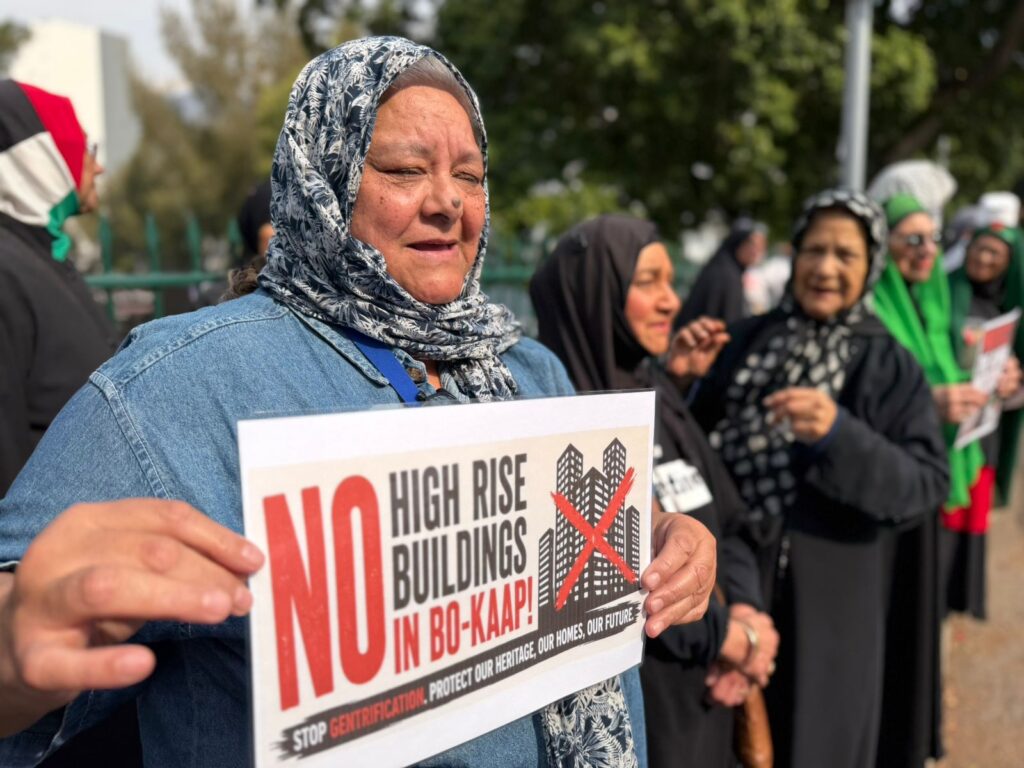
By Fazlin Fransman-Taliep
For more than two centuries, Auwal Masjid has anchored Muslim life in Bo-Kaap. Established in 1794 as South Africa’s first masjid, its significance extends far beyond this historic neighbourhood. It holds a sacred place in the history of a Muslim community whose roots at the Cape were forged through enslavement, exile and the struggle to worship freely.
Now, a six-storey aparthotel behind the masjid is testing what protecting that heritage means.
Residents fear Bo-Kaap will become a place where visitors can afford to stay, but longstanding families cannot afford to remain.
“We do not want our kids to read about Bo-Kaap in history books,” said Faa-iekah Ryland, secretary of the Bo-Kaap Civic and Ratepayers Association.
At 150 Buitengracht Street, behind Auwal Masjid, Flyt Property is marketing 67 furnished studio apartments operated by Wink Aparthotels for short-term stays.
The City of Cape Town says residents’ objections helped reshape the development. The original proposal was reduced from nine storeys to six, with overlooking features removed during consultation.


But the changes did not end the dispute.
On 2 July 2024, the City’s Municipal Planning Tribunal approved the revised development. Residents appealed, arguing that even at six storeys it remained too large for its historic setting and would change the historical character of the area.
In January 2025, the City’s Planning Appeals Advisory Panel recommended that the approval stand. The final decision, however, rested with Mayor Geordin Hill-Lewis in his role as the City’s appeal authority. On 27 May 2025, he dismissed the appeals and upheld the development approval.
“Few, if any, other development proposals have gone through such extensive community consultation, and iterative redesign,” he said.
That consultation now sits at the centre of two different accounts. The City points to the redesign as evidence that community participation changed the project. The civic association’s continued opposition suggests something more complicated: participation did not necessarily mean acceptance.
It also raises a larger question about who has a stake in Bo-Kaap’s heritage.
Some places are larger than the streets that hold them. Auwal Masjid stands in Bo-Kaap, but its meaning reaches far beyond the neighbourhood. As South Africa’s oldest masjid, it forms part of a wider story of Muslim faith, survival and belonging at the Cape.
Bo-Kaap’s heritage cannot be understood only through buildings and architecture. It also lives in religious practice, memory, family histories and an identity shaped over generations. The International Council on Monuments and Sites (ICOMOS), an advisory body to UNESCO’s World Heritage Committee, recognises that heritage can be valued by multiple communities.



Bo-Kaap is therefore more than the inheritance of those who live within its boundaries. Its masaajid, traditions and history carry meaning for Muslims across the Cape who understand the area as part of their own religious and cultural story.
These tensions resurfaced on 28 August 2026, when residents protested again, citing construction damage, parking pressure and possible future complaints about the athaan. After discussions with the developers reached an impasse on 31 August 2026, Auwal Masjid committee secretary Mogamat Cassiem Abdullah said their lawyers were due to file papers the following day.
“We would like to understand the process and know what our options are to challenge the development,” he added.
Flyt Property managing director Ryan Flowers maintains that the developer has followed the required processes over the past nine years, despite the continued opposition.
“Whilst we can appreciate the sensitivities, we have followed every due process over the last nine years,” he said.
For now, the approvals allow the project to proceed. However, the dispute has become about far more than one building, its height or its footprint. The question, then, is not only whether the physical heritage of Bo-Kaap can survive development, but whether the living heritage that made the place significant can continue to flourish alongside it.