Al-Qalam
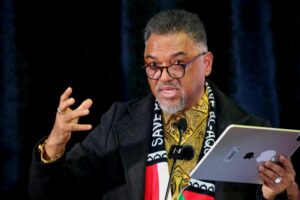
By Ebrahim Rasool (Former Ambassador to the USA)
In the month celebrating the birth of our beloved Prophet Muhammad (S), some strive to be obedient to his every utterance. Others yearn nostalgically for his leadership in a dangerous and fractured world. A few seek synergy with his divine mission and purpose. But the crucial question should be: How can we move us from effusive loving to profound living of the Prophetic legacy so that we locate the words of the Prophet (S) within his personality, and in turn, contextualise his words and habits in the Sirah – his entire life trajectory – while always mindful that his Sirah is the product of the Sunnah – praxis – with the Quran as divine fountainhead.
This is important for the Fiqhul Mu-amalat – the jurisprudence of contemporary engagement in the affairs of society, politics, economics, transactions, and the underpinnings of statecraft, nation-building and social cohesion. It is, therefore, a search for a methodology to access and animate the Prophetic legacy so that it speaks to us beyond the jurisprudence of worship – the Fiqhul Ibadah. We can rest with the dominant methodology of Taqlid or imitation in the performances of the various acts of worship and embrace the Prophetic advice: “Pray as you have seen me pray,” [Bukhari Bk10 H28] and enjoy it as it provides a signature and identity to the multitudes of Muslims across their diversities.
But taqlid may be somewhat unsustainable in the realm of the worldly affairs of Muslims. The root of taqlid in the Arabic language is “qa-la-da” which means literally to place a collar or necklace around the neck or to straight-jacket, with the implications of limiting choice, and reducing pragmatism, and narrowing adaptability, especially in a world where the state of the Ummah (the global Muslim community) is parlous and characterised, by and large, by domination and authoritarianism where we are majorities; by suspicion and islamophobia where we are minorities; by technological consumption and intellectual stagnation; and deep sectarianism and ambiguity in our relationship with difference.


The conundrum lies in how to access the Prophetic leadership and thus respond to the Quranic injunction: “In the Messenger of Allah, there is for you an Uswatun Hasanah for those who place their hope in Allah, who are mindful of the last day, and who remember Allah abundantly.” [Q33:21]. ‘Uswatun Hasanah’ means excellent example, beautiful template, or the best of patterns. The key, therefore, to regaining the dynamism of the ummah beyond imitation and literalism, lies in grappling with how uswah – example, template or pattern could lead to the dynamic and impactful followership of the Prophet (S) as envisaged in the Quran.
The ummah has historically been dynamic intellectually, scientifically, politically, and socially because it possessed ijtihadi tools for regenerating ideas and extending the frontiers of knowledge – through reading and writing; reasoning and analysising; synthesising and applying – for both the fiqhulibadat wa mu-amalat. These tools present themselves as qiyas and ijma – analogy and consensus. Simply put: If a new situation or challenge present themselves, an inclusive scholarship would look for an analogous precedent or a matter of some similarity on which to base a ruling for the new situation.
This intellectual device involved discerning essence from form. Where essence asks what principle must be preserved and transposed in an inviolable state from the original to the novel, while form asks what has changed in time and space and how will the essence give life to the new form and allow the faithful to be both true to history and circumstance.
Unless we are able to move beyond taqlid or imitation in the realm of the contemporary world, we are going to reproduce anachronisms: we will have successful revolutions that remove dictators but falter because our models recreate literally the so-called Islamic State; and where we proclaim such states, they will be synonymous with misogyny, kleptocracy, theocracy, dynasty, and a totalising instinct. Could we not rather posit the idea of emulation of the Prophetic tradition and suggest from the Arabic language and practice the notions of muhakah and iqtida?
Muhakah generally refers to simulation – often used in the ICT world – meaning the transference or reproduction of a property or quality from one application or context to another. Iqtida, on the other hand refers to role-modelling, desiring the outcomes exemplified in another application or person, and following another’s pattern or template for success. Muhakah thus speaks to the transference of the principle or essence in another context, while iqtida is more closely aligned with the Quranic injunction to model ourselves on the Prophet Muhammad (S). Both show a way beyond taqlid or imitation and moves us towards emulation.



But for this to succeed in a dangerous world and in a fragile ummah, we must understand that the critical principles to be transferred are those consistent with the intents of Islam and the shariah – al maqasid al shariah, where the context has changed, but without the preservations or rights being compromised. The implications of emulation for statecraft, for example, mean that if we are not trying to imitate the form of the state (the khilafat) but can rather emulate the Prophetic intents and values in another form, then you could potentially have an inclusive, rights-based state underpinned by salaam (peace), amaan (security), shura (consultation), and hurriyyah (freedom).
It may just be that an emulative approach towards the Prophetic tradition will shift us from the nostalgic love for the Prophet (S) to a strategic appreciation; from loving Muhammad (S) profusely to living his uswa seamlessly and successfully; and from being an ummah justifiably proud of our past to one confidently recreating a golden future from the Prophetic legacy.
*Ebrahim Rasool is former ambassador to the U.S. and former Premier of the Western Cape