Al-Qalam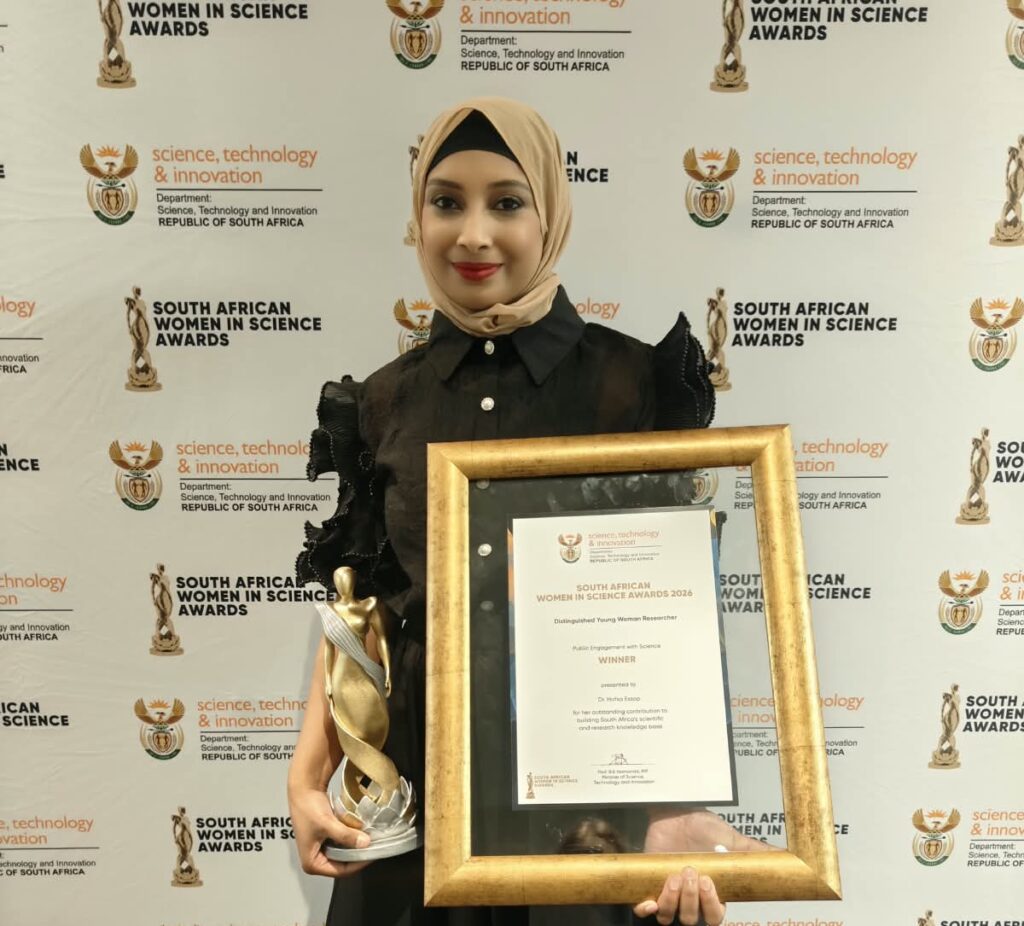
By Azra Hoosen
When Dr Hafsa Essop was pregnant with her first daughter, she was given a dosimeter to monitor radiation exposure to her unborn baby. But there was one problem – she did not know how to use it.
When she asked colleagues who had previously been pregnant, she discovered that they had not used the device either or tracked their foetal doses. “I found this very concerning, as a device that is meant to protect the fetus during pregnancy was not being utilised properly and therefore doses were not accurately recorded,” she said.
That experience led Dr Essop, a senior lecturer in Radiography at the University of Pretoria, to investigate the issue through her research and ultimately develop PregiDose, a prototype mobile application designed to improve foetal dose record-keeping and radiation safety among pregnant healthcare workers.
Her work has now earned her the 2026 South African Women in Science Awards (SAWiSA) Distinguished Young Woman Researcher Award in the Public Engagement with Science category.
“As a mother, you are overly aware and cautious about everything. Pregnant workers have even more fears, because the radiation environment has the potential to cause harm to the fetus if exposed to high radiation levels. It is therefore imperative that they are carefully monitored and fully supported,” she explained.


The prototype was developed using a user-centred approach, allowing Dr Essop to understand the concerns and challenges faced by pregnant workers in radiation environments.
“My dream is for PregiDose to one day be a leading brand in pregnancy dosimetry, InshaAllah. The road is of course long, but I truly believe that this app and vision will benefit pregnant workers, both in South Africa and globally,” she said.
But the purpose of her research extends beyond earning a qualification. “I strongly believe that research is a catalyst for change, it identifies problems and provides solutions. Truly impactful research is one whereby you don’t just get a qualification from it, but people benefit in a positive way, because of what you have recommended or developed,” she said.
As a Muslim woman working in science and academia, Dr Essop said she strongly resonates with the hadith: “The most beloved people to Allah are those who are most beneficial to people.” (al-Mu’jam al-Awsat)
She approaches her work with this in mind, whereby her success also lies in the success of those around her. “In academia, there is the proverbial PhD – Pull her Down. I strive every day to make sure that I try to uplift and be of benefit to those around me,” she said.
Her identity as a Muslim woman has also remained important to her. “I also believe wearing my hijab in this space has given me a strong, unwavering identity as a Muslim. I am still able to continue with my work and perhaps excel in my work, without having to ‘fit in’ and I think that is important,” she said.
Dr Essop’s work has extended to the international stage through her involvement with the International Commission on Radiological Protection (ICRP). She received the ICRP Claire Cousins Award in 2023 and contributes to international research on radiation protection. Her current postdoctoral research focuses on foetal dose record-keeping and recommendations that could inform international policy.



She has published 15 peer-reviewed articles, presented at national and international conferences and serves on the Pregnancy and Paediatric Task Group of the Society of Radiographers of South Africa. She has also been appointed Scientific Chair for its 2027 Congress.
Despite these achievements, Dr Essop does not describe herself as someone who always had everything figured out. “I was not the smartest girl in the class; I did not have it all figured out, but one thing I always had was a deep sense of wanting to help people,” she said.
That desire continues to shape her message to young Muslim women considering science, healthcare or research. “The world needs you. We are facing so many contextual challenges that can often be solved through science. It’s not only about getting a qualification, but it’s about using that qualification, knowledge and your hands to be of benefit to mankind,” she said.