Al-Qalam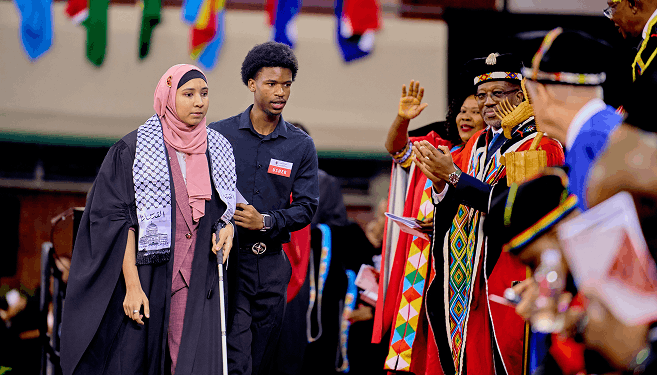
By Azra Hoosen
From SA Top Achiever to Summa Cum Laude, everything changed the moment Azraa Ebrahim stopped asking ‘Can I?’
The young scholar recently graduated from the University of KwaZulu-Natal with a Bachelor of Arts Honours degree in Religion and Social Transformation, achieving Summa Cum Laude distinction and averaging above 80% across all her modules.
Born with Congenital Bilateral Optic Nerve Atrophy, a rare degenerative condition affecting her vision, Azraa first drew national attention in 2021 after achieving the highest results among special needs schools in KwaZulu-Natal and placing second nationally. Since then, she has continued carving out a space for herself in academia, while using her platform to speak about disability, inclusion and representation within Muslim spaces.
Beyond academia, Azraa has presented at national conferences, travelled independently and returned to her former high school as the guest of honour at its Senior Prizegiving ceremony.
But long before the accolades and public recognition, there was a young girl trying to understand why she had been born blind. “Throughout my life, Islam has been my compass, offering direction through both triumph and hardship,” Azraa told Al-Qalam.


As the only learner with a disability in a mainstream Muslim school during her primary school years, she faced bullying and exclusion that deeply shaped her understanding of herself and the world around her. “It was through Islam, particularly Sufism, that I found the tools to not only endure those experiences but transform them into sources of personal strength and purpose,” she said.
For Azraa, the concepts of sabr and tawakkul became living practices. “Islam taught me that struggle carries meaning, and that understanding fundamentally changed how I experience my disability, not as something to overcome, but as part of a purposeful journey,” she said.
That understanding followed her into university, where the challenges became less visible but no less demanding.
“Being blind means that a lot of things take longer. Every piece of learning material had to be worked through carefully and completely.”
Using a screen reader to access academic material meant that even simple formatting issues could become major obstacles. Most of her studies were completed on her phone, often while managing severe eye pain.
Still, she pushed through.
“Achieving Summa Cum Laude required discipline, consistency and a genuine love for the process itself,” she said.
One of the most demanding parts of her Honours year came during presentations. Unable to rely on cue cards or slides, Azraa memorised entire scripts before presenting them. “What surprised me was that this became one of my favourite parts of the process. Memory is genuinely my greatest strength,” she said.



For Azraa, the shift in her life came when she stopped seeing blindness as something standing in opposition to her ambitions. “For a long time, I asked myself, ‘Can I or can’t I?’. The moment I replaced that with ‘how will I?’ everything changed,” she said.
That perspective has also shaped the way she understands representation. Growing up, she seldom encountered stories of Muslim women with disabilities succeeding academically or publicly. “The absence of role models that looked like me growing up is precisely why I understand the weight of the position I now occupy,” she said.
Azraa credits much of her confidence to her parents, who refused to raise her within the limits society often places on disabled children. After noticing how bullying had caused her to retreat into herself as a child, they enrolled her in karate. Years later, she earned her black belt.
Now preparing for her Master’s research on disability in Islamic digital spaces, Azraa hopes to push conversations within Muslim communities beyond accommodation and toward genuine inclusion. “I want the voices of disabled Muslim women to move from the margins to the centre. As one of the very few researchers with a disability working in this field in South Africa, I am aware that my presence in these conversations is itself an argument for why they need to happen,” she said.