Al-Qalam
By Aslam Fataar
Muslim schools operate under increasingly demanding conditions. Teachers must complete the curriculum, prepare learners for examinations, respond to uneven levels of learner preparation, manage social and economic pressures, and now contend with digital distraction and the rapid incorporation of generative AI into young people’s lives. Under these conditions, teaching can easily narrow to coverage, performance and examination preparation.
The challenge is not to lessen the importance of academic achievement. Learners need serious access to disciplinary knowledge, intellectual standards and the forms of reasoning associated with their school subjects. The larger educational question is how such knowledge can be taught in ways that also contribute to the formation of the learner as an ethical human being.
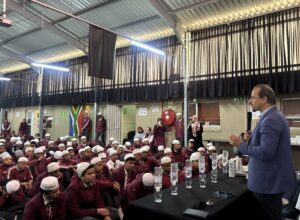
This question framed the workshop, Teaching with Iḥsān: A Prophetic Pedagogy of Islamic Ethics for Muslim Schools, held at Community House in Salt River, Cape Town, on 26 September 2026. Stellenbosch University’s Dialogue, Democracy and Development project presented the workshop in association with The Muslim Thinker Trust, coordinated it. It combined conceptual input, an interactive presentation, generative group work and report-backs, with a strong emphasis on translating Prophetic ethics into pedagogical practice.
The classroom as a formative space
The workshop proceeded from the view that the classroom is simultaneously a knowledge space and a formative space. Teachers have an epistemic responsibility to teach subjects with intellectual seriousness. Learners require access to concepts, evidence, procedures, disciplinary reasoning and clear standards for what counts as knowledge.


At the same time, schooling always forms learners. Knowledge is taught through relationships, routines, expectations, examples and patterns of interaction. The important question is therefore not whether formation occurs, but what kinds of dispositions, habits and ethical orientations are being cultivated through the everyday experience of teaching and learning.
This is where Prophetic ethics becomes educationally significant. It should not be reduced to occasional moral reminders or treated as a separate layer added to the formal curriculum. The deeper task is to bring knowledge, pedagogy and ethical formation into meaningful relation.
Adab, akhlāq and formation
The distinction between adab and akhlāq provided an important language for this work. Adab refers to visible conduct in relationships and situations. It concerns how learners speak, listen, disagree, use technology and participate in learning. Akhlāq refers to the deeper moral character and dispositions from which such conduct increasingly flows.
The pedagogical implication is that character formation cannot be achieved through exhortation alone. Learners need repeated opportunities to practise attentiveness, honesty, fairness, respect, responsibility and care. Through repetition, guidance and reflection, these visible forms of conduct can gradually become more deeply rooted dispositions.
The learner should therefore not only know more at the end of a lesson. The classroom experience should also contribute, over time, to how that learner listens, speaks, judges and acts.
A pedagogical grammar for Prophetic ethics
The workshop used the Islamic categories of taʿlīm, taʾdīb and tarbiya to give this educational purpose a pedagogical grammar. Taʿlīm concerns what learners should know and understand. Taʾdīb concerns the forms of conduct and disposition that should accompany that knowledge. Tarbiya concerns the longer process through which repetition, modelling, correction, and increasing responsibility nurture such formation. Iḥsān gives this process its orientation towards excellence, beauty and right action.



This grammar locates Prophetic ethics within the ordinary work of teaching. Teachers already make choices about what knowledge matters, how it should be made teachable and what counts as evidence of learning. The workshop asked how ethical formation could enter these existing pedagogical decisions.
Basil Bernstein’s idea of pedagogical recontextualisation helped clarify this. Knowledge is selected, reorganised and translated for particular learners and educational settings. Muslim teachers must consider how Prophetic ethical resources can be recontextualised into school subjects while retaining both disciplinary integrity and the integrity of the ethical tradition.
A phased and temporal pedagogy
A core feature of the workshop was its emphasis on developmental pacing. Ethical formation looks different at different stages of schooling. Young children learn powerfully through attachment, imitation, story, rhythm and routine. As learners mature, they become increasingly able to understand consequences, interpret situations, discuss competing claims and accept responsibility for their judgments and actions.
The ethical purpose can therefore remain coherent across the school while the pedagogy changes. Younger learners may first experience goodness through modelling and repetition. Intermediate learners can increasingly explain why conduct matters. Senior and FET learners can engage questions of identity, responsibility, public life and moral judgment.
This temporal logic matters because ethical education should grow with the learner. It should move from guided practice towards increasingly independent interpretation and ethical agency.
Memory, embodiment and discernment
The Cape Mawlid offered a locally grounded example of formation through more than verbal explanation. Its pedagogical force lies in voice, repetition, listening, rhythm, bodily participation and communal memory. Children learn through hearing, repeating and gradually inhabiting particular forms of attentiveness and belonging.
The broader lesson is that learners are shaped by what they repeatedly hear, see and do. Classroom routines, the handling of mistakes, the modelling of disagreement and the repeated practice of honesty, care and responsibility all contribute to who learners are becoming.
The workshop also addressed conditions that can morally and socially disorient learners. The concept of fitan (times of turmoil and moral confusion) was used to name pressures such as online cruelty, racism, inequality, sexualised content, AI misuse, peer pressure and public violence. Within this context, dhikr was approached as remembrance and also as re-membering: restoring moral orientation when attention and judgment have become fragmented.
The educational aim is to help learners pause, notice what is happening, recall what matters, weigh the ethical dimensions of a situation and determine how to respond responsibly. Prophetic education should therefore move beyond rule repetition towards ethical discernment and agency.
Making inherited knowledge educationally alive
The example of Shaykh Yūsuf illustrated how knowledge travels, circulates and becomes recontextualised in changing historical conditions. This offers a useful metaphor for Muslim schooling. Inherited knowledge must retain its integrity while becoming meaningful in the circumstances learners actually inhabit.
Prophetic narratives can similarly become ethical resources through which learners examine care, dignity, hospitality, race, injustice, harmful conduct and repair. The educational task is to create opportunities for learners to interpret inherited knowledge and connect it thoughtfully to contemporary situations.
The discussion of generative AI made this need especially visible. The educational question is broader than whether AI should be allowed. It concerns digital adab: honesty, verification, responsibility, privacy, dignity and intellectual ownership. Learners need to gradually develop the capacity to explain how AI was used, check claims and take responsibility for the knowledge they present.
Educating for Prophetic ethical agency
The workshop’s design reflected its argument. Conceptual input was combined with interactive presentation, collaborative design work and report-backs. Teachers moved between conceptual understanding and classroom application, made their pedagogical thinking explicit, and refined it collectively.
Teacher development for Prophetic ethics cannot remain at the level of inspirational discourse. Teachers need conceptual resources and structured opportunities to translate them into teachable practices appropriate to particular subjects, phases and situations.
The wider aspiration is to understand Prophetic ethics as a serious pedagogical pursuit. Muslim schools should aim for strong academic achievement while also cultivating attentiveness, character, discernment and ethical agency. Prophetic pedagogy concerns the quality of the entire educational encounter: what learners come to know, how they learn to inhabit that knowledge, what kinds of judgment they develop, and how their education equips them to act responsibly.
The educational ambition is therefore larger than examination success. It is to cultivate young people whose knowledge becomes part of their character, whose character informs their judgment, and whose judgment enables them to respond to the world with responsibility, dignity and iḥsān.
*Aslam Fataar is Research Professor in Higher Education Transformation in the Department of Education Policy Studies at Stellenbosch University.