Al-Qalam
With Eid around the corner, thousands are scratching around to put something on the table. Middle East Eye reports.
As the US-Israel war on Iran began last week and Gaza’s crossings were shut, panic has spread through the densely populated enclave, raising fears of a famine returning.
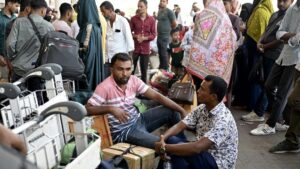
Palestinians rushed to markets to stock up on essentials, as soaring prices and shortages of key items, particularly vegetables, signalled the impact of the closures.
Gaza depends almost entirely on border crossings for the entry of food and essential goods, meaning any sudden closure is quickly reflected in local markets and household budgets.
For Ibrahim Madoukh, a father of eight from al-Sahaba neighbourhood in Gaza City, the price surge has already begun to affect his family’s fragile livelihood.
Since the October ceasefire, Madoukh has been selling falafel from a small stall to support his family. Demand had been steady, he said, largely because he kept his prices low.
But rising ingredient costs have forced him to increase prices, while customers – many already struggling financially – are buying less.
“The economic situation in Gaza has been deteriorating since the war,” Madoukh said. “Many people can no longer afford what is available in the market.”
After hearing about the crossing closures, Madoukh rushed to buy supplies before they disappeared. Instead, he found markets crowded with residents trying to do the same.
The price increases were immediate and dramatic. A kilogram of onions that once cost three shekels (around $1) now sells for 15 shekels (around $5). Cooking oil has jumped from 5 shekels (around $1.5) to 13 shekels (around $4), while the price of parsley has risen eightfold.
“Traders say prices are rising because the crossings are closed and supplies are running out,” he said.
Madoukh has already been forced to raise the price of his falafel from two pieces for 1 shekel to one piece for 2 shekels.
Even so, many families still cannot afford it.
“Before the crossings closed, displaced children sometimes came to my stall asking for falafel because they were hungry and had no money,” he said. “I used to give it to them, but now I can’t. I’m already losing money.”
Israel closed all crossings into Gaza last Saturday, halting the movement of people, aid and goods, shortly after the war with Iran began.
The Karem Abu Salem crossing with Israel was partially reopened on Tuesday, allowing limited entry of fuel and humanitarian aid, while other crossings, such as the Rafah border with Egypt, remain shut.
The UN has called for more crossings to reopen to scale up humanitarian support, particularly as many NGOs in the Strip face restrictions.
Metres from Madoukh’s falafel stall, Ahmed al-Shoubaki, 39, was stocking up on supplies for his family. Carrying a large bag filled with tins, tahini, ghee, spices and olive oil, he carefully asked a vendor about the price of sugar.
“Since the crossings closed on Saturday, I’ve been going to the market every day to buy whatever I can and store it at home,” Shoubaki told Middle East Eye.
“My wife and I agreed to keep the staples like flour, cooking oil, and canned goods untouched, buying only daily necessities from the market while they last.”
Before the Israeli genocide in Gaza, Shoubaki worked as a painter, but shortages of materials forced him to switch careers. He opened a small food stall selling kebab and grilled chicken, which he had to close last month due to declining sales.
His story mirrors the experience of thousands of Palestinians in Gaza who have lost their livelihoods as entire sectors have ceased operating.
“The economic situation in Gaza has collapsed. There is no work, so no one can cope with rising prices,” he said.
“When I heard about the (Iran) war, I spent more than $1,000 – almost all my savings – buying supplies to last a month. I don’t know how I’ll manage later, but I had to do it. My children cried from hunger last Ramadan; I can’t let that happen again.”
Shoubaki condemned the suffering imposed on Gaza, which he says has no role in the Iran-Israel conflict.
“Why must Gaza pay the price for wars it’s not involved in? Our lives are already hell from siege, destruction, and hunger.
“Death would be more merciful than living through this continuous suffering. I fear the crossings will remain closed for a long time, and our suffering will only continue.”