Al-Qalam
By Imraan Buccus
The collapse in support for the ANC, the EFF’s continuing decline, MKP’s dominance in KwaZulu-Natal, the alarming surge in support for the far-right ActionSA and the DA’s growing strength are important developments. All require careful analysis.
But there is a deafening silence around the fact that most South Africans entitled to vote did not do so.
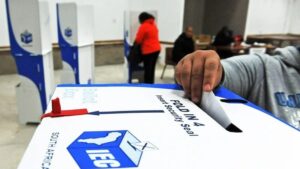
The Electoral Commission reported on Thursday that an estimated 15.9 million people had voted, including special voters. This remains a provisional figure while counting continues. There were 29.23 million registered voters, giving a turnout of about 54% of the voters’ roll, an improvement on the 46% recorded in the 2021 municipal elections.
Yet the voters’ roll excludes millions of eligible citizens. According to Ipsos, South Africa has about 44.9 million adults eligible to vote, of whom only 29.2 million are registered. That means roughly 15.7 million have not registered at all. On the provisional figures, only 35% of eligible South Africans voted this week. Around 29 million did not. Almost two-thirds of the electorate stayed outside the polling stations.
In a society with our history of mass democratic mobilisation, this should be a much larger political scandal than another shift in the balance of power between parties.


This is easily obscured when election coverage moves directly from vote shares to council seats. A party may secure a majority in a municipality while commanding the active support of only a minority of those entitled to vote. The council is legally constituted; its capacity to claim meaningful political representation is another matter.
Local elections generally attract fewer voters than national elections, in South Africa and elsewhere. Yet periods of profound crisis can also bring people to the polls, especially when they believe that an election offers a chance to change their circumstances. South Africa has more than enough reasons for popular anger.
Official unemployment stood at 33.6% in the second quarter of this year, rising to 43.8% when people who want work but are not actively looking for it are included. Among young people aged 15 to 24, unemployment reached an astonishing 62.8%. Millions have little prospect of secure work. Violent crime is a daily reality in many communities. Corruption is rampant, including in the police. Municipal services have deteriorated badly, and Johannesburg, the country’s economic centre, has become a shocking example of the rapid decay of urban government. Water failures, broken roads and a collapsing public environment are increasingly grim facts of life.
The failure of these conditions to generate a much larger electoral response demands explanation. It is not enough to blame apathy or lecture people about their civic duties.



There is direct evidence of the depth of political alienation. In the latest Ipsos survey, 53% of eligible South Africans said that no political party represented their views, up from 47% in an earlier survey. Half of registered voters felt the same way. In a country with more than 600 registered political parties, that is an extraordinary indictment of the political class.
The ANC’s decline forms part of this history. For decades it could draw on the authority of the liberation struggle and extensive ties to working-class communities. Corruption, economic stagnation and the decay of public institutions have steadily exhausted that political inheritance. The liberation movement that once mobilised millions now struggles to convince people that it can run a municipality.
The EFF promised a radical alternative to the ANC, but has become heavily dependent on the personality of its leader and theatrical confrontation. Its participation in the government of corrupt and incompetent municipalities has damaged its credibility. Its decline shows that demagogic radical rhetoric is no substitute for a credible political vision and the organisation needed to advance it.
The political consequences of this vacuum are already visible. ActionSA’s advance shows how anger at municipal collapse can be mobilised by the far right, directing popular resentment towards migrants and other vulnerable minorities. Alienation from established parties does not automatically produce democratic alternatives. Neither the decline of old parties nor the rise of new ones will resolve the crisis if most people remain outside the political process.
The most obvious way to draw people back into political life is to build parties that genuinely speak to their material circumstances, hopes and aspirations. Lula’s victory in Brazil last month showed that a mass political project rooted in the lives of ordinary people can still defeat the right. Zohran Mamdani did something different, but equally instructive, in New York last year, with a campaign organised around housing, transport and the cost of living. Jeremy Corbyn’s 2017 campaign in Britain also showed how a credible break with exhausted political orthodoxies could energise people who had ceased to believe elections mattered.
South Africa’s glaring omission is a credible democratic left rooted in working-class communities and the lives of the unemployed. The SACP is too doctrinaire to fill this space, and its complicity with xenophobia at its failed conference of the left has severely damaged its credibility amongst the wider left and people of good conscience. But the point is not simply that the left needs another party. It is that the millions who feel politically unrepresented need somewhere to take their demands, and some reason to believe that participating can change things.
Elections cannot sustain a democracy by procedure alone. If most eligible citizens continue not to vote, the distance between democratic institutions and the people in whose name they govern will grow. That is fertile ground for opportunists and demagogues who promise to sweep aside constraints and speak for a betrayed people. South Africa’s democracy was won through mass participation. Its future depends on restoring the conviction that ordinary people can act together to shape the country, rather than merely watching parties compete for power they no longer trust.
*Dr Buccus is editor of Al-Qalam.