Al-Qalam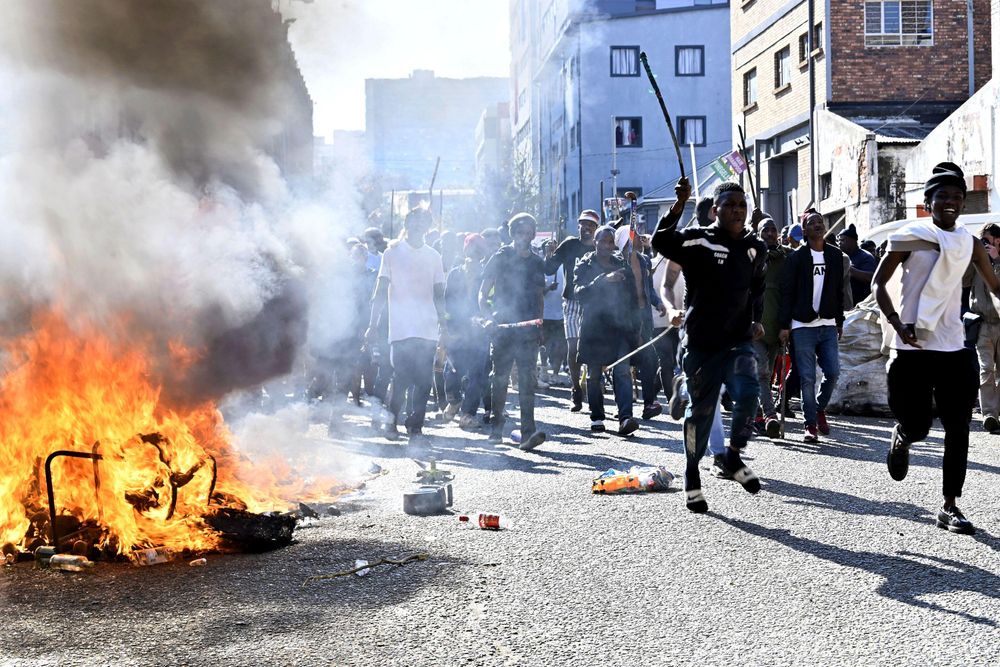
By Salim Mohamed Badat
Across various parts of the country, self-appointed groups are entering businesses, questioning employers, inspecting workplaces, identifying foreign workers, and demanding to know who is legally employed.
Regardless of the names these organisations give themselves, one question rises above all others: who has authorised them to enforce the law?
There is no denying that illegal immigration is a legitimate national concern. Every sovereign nation has the right, and indeed the duty, to protect its borders, regulate immigration, and ensure that those living and working within its territory comply with the law. South Africans are equally entitled to expect that these laws are enforced fairly and consistently.
Yet the responsibility for doing so has always rested with the state. The ANC government since 1994 has failed to adequately secure the country’s borders and enforce immigration laws. This has fuelled public frustration and a growing sense that the government has neglected one of its most fundamental responsibilities.
That failure is not an invitation for private citizens to become law enforcement officers. Border security, immigration enforcement, and the lawful deportation of undocumented foreign nationals are constitutional functions of the state. When government fails to act decisively, it creates a vacuum, and vacuums are often filled by self-appointed groups.
This is precisely where South Africa now finds itself. The grievances expressed by many of these groups are understandable. Citizens are concerned about unemployment, pressure on public services, crime, and the perception that immigration laws are not being enforced. These concerns deserve to be heard. But legitimate concerns cannot justify illegitimate methods.
When private groups enter businesses without lawful authority, interrogate workers, intimidate employers, and conduct what amount to their own immigration inspections, they move beyond civic activism into an area that threatens the rule of law.
The Constitution was never intended to permit citizens to appoint themselves as immigration officials or police officers. Our democracy depends upon due process, lawful authority, and equal protection under the law.
Once those principles begin to erode, the consequences become increasingly difficult to contain.
Today it may be businesses employing foreign nationals; tomorrow it could be farms. The next day it could be factories, schools, shopping centres, or any institution targeted by whichever group believes it has the authority to intervene.
History shows that vigilantism rarely remains confined to its original purpose. Once groups become accustomed to exercising power without legal accountability, that power often expands.
An equally serious concern follows naturally. If businesses become accustomed to groups arriving unannounced and demanding access, what prevents future groups from demanding payment instead?
What stops criminal syndicates from presenting themselves as community organisations? How long before intimidation evolves into organised extortion?
These are not hypothetical fears. They are risks that emerge whenever lawful authority is gradually replaced by informal power.
The silence from the government has only intensified public concern. Many South Africans are asking: Where is President Cyril Ramaphosa? During periods of heightened public tension, citizens reasonably expect visible leadership, clear communication, and decisive action.
When that leadership appears absent, uncertainty grows, confidence weakens, and speculation inevitably fills the void.
Government now carries a dual responsibility. First, it must urgently restore public confidence by strengthening border security, improving immigration administration, enforcing existing laws, and lawfully deporting those who have no legal right to remain in the country.
Secondly, it must make it unmistakably clear that no private group, regardless of its motives, may assume the powers of the state or take the law into its own hands.
South Africa’s Constitution protects the rights of businesses as well as individuals. Inspections and enforcement actions must be carried out by authorised officials acting within the law, not by self-appointed groups demanding access to private premises.
The Freedom Charter envisioned a South Africa founded upon justice, equality, dignity, and the rule of law. Our constitutional democracy cannot allow parallel systems of enforcement to emerge simply because public frustration has reached breaking point.
South Africa stands at a defining moment. If we excuse vigilantism because we agree with its immediate objective, we may one day discover that the same methods are being used for very different purposes.
The issue before us is larger than immigration. It is about whether we remain a constitutional democracy governed by law, or gradually become a society where organised groups exercise authority simply because they can.
Government must take responsibility for the conditions that have contributed to this moment. It must address the legitimate concerns of its citizens through effective governance, economic growth, secure borders, and the consistent application of the law.
But it must do so within the framework of the Constitution, because once the rule of law gives way to the rule of the crowd, everyone, citizen and non-citizen alike, ultimately becomes less secure.
The choice South Africa makes now will shape not only its immigration policy, but the future character of its democracy.