Al-Qalam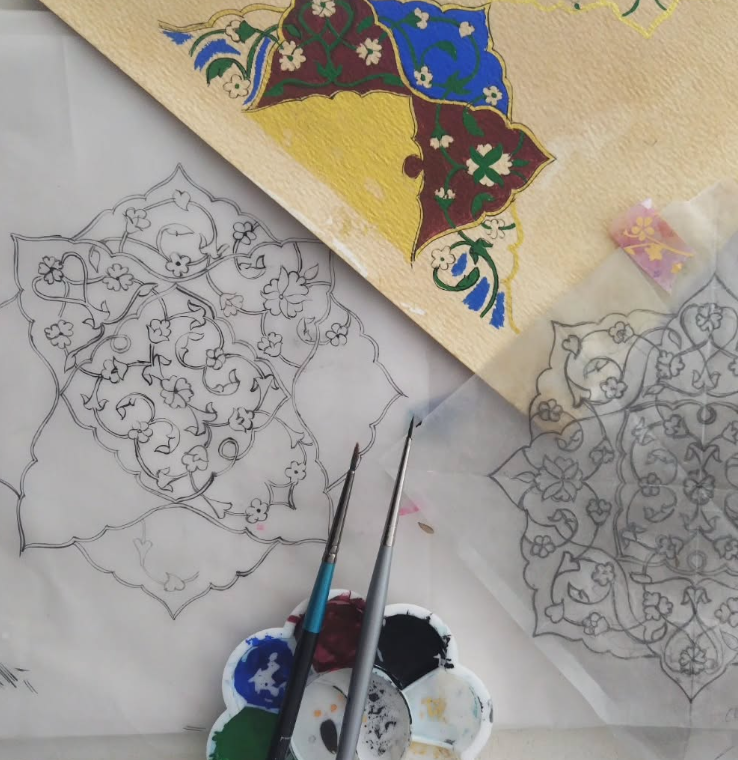
By Sana Ebrahim
As Eid al-Fitr approaches, families begin preparing for one of the most joyful days on the Islamic calendar. Alongside the traditional sweets, new clothing and perfumes exchanged during the celebration, many people are also seeking gifts that carry a deeper meaning. Ottoman-inspired Islamic art offers one such option, blending spirituality, heritage and craftsmanship into pieces that can be treasured for years.
Occupational therapist and Ottoman art practitioner Nazeemah Soomar believes that traditional Islamic art holds a special place in celebrating occasions such as Eid.
Traditional Turkish art dates back many centuries and reached a peak during the Ottoman era. Artists used natural pigments derived from minerals and plants, along with delicate applications of gold leaf. These meticulous techniques helped many historic works survive for generations and remain preserved in museums today.
Ottoman illumination and calligraphy formed part of the wider tradition of Ottoman book arts. These techniques were used to decorate Qur’anic manuscripts, official documents and artistic panels, often featuring intricate patterns and elegant floral motifs.
For Nazeemah, Ottoman art carries meaning far beyond decoration.
“Ottoman art is a labour of love,” she explains. “It reflects love for Allah’s words and for the beauty Allah created in nature.”


Calligraphers carefully write sacred texts or meaningful phrases, while illumination artists frame the words with balanced designs and stylised florals. The result is a composition that reflects harmony, a central principle within Islamic artistic tradition.
Historically, Islamic art appeared in several forms, including architecture, functional objects such as tiles or vessels, and decorative artworks. Across these forms, beauty was regarded as an essential element of life.
“Islam encourages balance, harmony and goodness,” Nazeemah says. “Beauty reflects Allah’s nature and helps create peaceful spaces.”
Nazeemah’s love for art began early, although opportunities to explore it were limited during her school years.
“In the early 1990s there was very little exposure to the arts in our communities,” she recalls. “Art was often seen as something low on the ladder in terms of career choices.”
Despite this, her passion endured. Over time, her appreciation for art deepened alongside her spiritual journey.
“Art became a way of recognising Allah’s beauty,” she told Al-Qalam. “It also reflects one of Allah’s attributes, Ya Khaliq, the Creator.”




For Nazeemah, gifting Islamic art during this time offers an opportunity to reconnect with cultural and spiritual heritage.
“In many places we do not live in societies where Islamic culture is dominant,” she says. “For centuries, we have often looked to the West for artistic inspiration. Reviving traditional Islamic arts helps us rediscover our own heritage.”
Calligraphy holds a particularly important place within Islamic tradition. The Qur’an itself references the pen, highlighting the significance of knowledge and writing. Receiving a handmade artwork can therefore carry both spiritual and emotional meaning, she added.
“A piece of art created by hand builds a connection. It brings harmony into the home and the heart of the person receiving it.”
“Art has lasting value,” Nazeemah says. “It is like a bouquet of flowers that never fades.”