
 Al-Qalam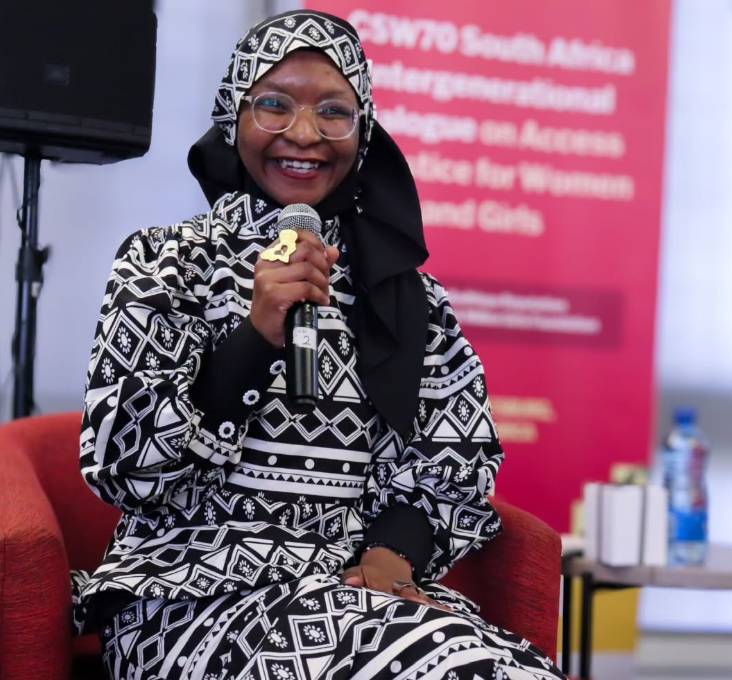
By Neelam Rahim
Access to justice remains a pressing challenge for women and girls in South Africa. From economic exclusion and land insecurity to gender-based violence and systemic discrimination, many still face barriers that prevent them from fully exercising their rights and safeguarding their dignity. Across the country, activists and advocates are working tirelessly to ensure that justice is not only a legal principle on paper but a lived reality for all.
Among these voices is Nurulhudah Okwayo, an alumna of the Auwal Socio-Economic Research Institute (ASRI) and an advocate whose work spans grassroots activism and global policy spaces. Speaking to Al-Qalam, she shared how her commitment to women’s rights has been shaped by both lived experience and the values instilled through her faith and leadership training.
“As I grew older, I realised that access to justice is bigger than individual cases,” Nurulhudah explains. “It is about the kind of justice a society chooses after harm, particularly for those who have historically been excluded.” In South Africa, many women and girls continue to live with the aftershocks of dispossession, economic insecurity, and systemic inequality. For her, justice is not simply a policy goal; it is the bridge between rights on paper and dignity in reality.



Her journey has been further strengthened through ASRI, which she describes as a space that nurtures ethical leadership and practical skills. “ASRI reminded me of the importance of ethics and accountability in public life,” she says.
“It strengthened my confidence to navigate formal policy spaces while remaining guided by values of fairness, integrity, and service – principles at the heart of Islamic teaching.” Beyond technical skills, ASRI provided a network of peers and mentors, reinforcing the idea that leadership is about uplifting communities and holding systems accountable, not personal acclaim.
On 2 December, Nurulhudah took part in the CSW70 South Africa Intergenerational Dialogue, convening multigenerational voices to advance accessible, survivor-centred, and transformative justice for women and girls. She emphasised that justice must be inclusive and grounded in lived realities. “Many systems remain urban-centric, slow, and detached from women’s daily lives,” she explained. “Access to justice must go beyond criminal cases to include land, inheritance, education, economic security, and reparative measures. Dignity and safety are intertwined, and they must be at the centre of all justice efforts.”
She was struck by the structural and systemic barriers women continue to face. Justice often feels out of reach because services are centralised, costly, and procedurally complex. Informal or customary avenues, while more accessible, can reinforce patriarchal norms, particularly in cases of gender-based violence or property disputes. “For too many women, access to justice doesn’t feel guaranteed; it feels like a struggle,” Nurulhudah notes.




She also highlighted the importance of intergenerational dialogue. “Older generations bring hard-earned lessons and institutional memory, while young women bring urgency, innovation, and new tools. These spaces should not end at conversation; they must lead to action that transforms systems.” Young women, she adds, are critical in shaping contemporary notions of justice, from economic inclusion and land security to protection against tech-facilitated harm and in holding institutions accountable and responsive.
Looking ahead, Nurulhudah stresses that commitments must translate into real-world action. One tangible outcome of the CSW70 dialogue is the Africa Intergenerational Declaration on Strengthening Access to Justice for All Women and Girls, which sets out concrete actions and measurable priorities. Practical steps include decentralising justice services, strengthening survivor-centred pathways, and ensuring proper accountability through adequate resourcing, oversight, and consequences for failures.
“Access to justice must be broader than criminal law,” she tells Al-Qalam. “It must include land, education, economic security, and reparative justice, because dignity, safety, and opportunity are deeply connected.” For Nurulhudah, this work is both a professional mission and a moral imperative guided by Islamic principles: fairness, integrity, and the protection of human dignity.

