Al-Qalam
[Pictured: Moulana Junaid Kharsany addresses the attendees at the MSA Iftar - Howard College Jamaat Khana]
By Azra Hoosen

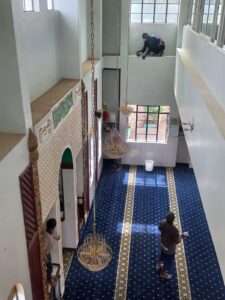
The UKZN Muslim Students Association (MSA) hosted a mass iftar at the Howard College Jamaat Khana recently, which brought together over 130 students from across campus to break their fast in a setting that reflected the spirit and etiquette of Ramadan.
The event itself had long been part of the MSA’s plans but had not been organised in recent years.
MSA UKZN Westville Chairperson, Hafidh Ebrahim Vaid, told Al-Qalam that a reminder from a recent Jumu’ah speaker about the virtues of hosting a mass iftar, and the importance of unity within the Muslim community, ultimately inspired organisers to prioritise it.
The intention behind the gathering was clear: to foster unity among students. “One of the foundational principles of Islam is the concept of brotherhood and belonging to one ummah,” said Vaid.
While mass iftars on campuses are sometimes criticised for becoming purely social events, the organisers were deliberate about maintaining an environment rooted in Islamic practice. MSA UKZN Westville Vice Chairperson, Abdullah Khan, said that the venue had separate entrances and facilities for brothers and sisters.
Khan explained that the evening was structured to keep the focus firmly on the spiritual significance of the month. With naseehat and talks delivered by Moulana Ismail Moosa and Moulana Junaid Kharsany, while students also marked the completion of a Qur’an khatam and participated in a collective dua before breaking their fast.
Maintaining modesty and boundaries was also a key priority for organisers. “Our Prophet (PBUH) said modesty is part of faith. As the hosts of this event, it was our responsibility to ensure that this article of faith was upheld. A few members stood guard and ensured no one lingered outside the gathering,” explained Vaid.
He noted that students from different cultures, backgrounds and age groups attended: “At a time when there are many challenges and disruptions taking place around the world, it is especially important for Muslims to strengthen their bonds with one another and stand together in unity.”
For many students studying away from home, Ramadan can feel very different from the warmth of family iftars. One attendee said the gathering offered students a sense of comfort and belonging: “Being away from home is already a significant adjustment and during Ramadan, many students feel that distance even more strongly. Breaking fast with other Muslim students feels comforting. It becomes like a family away from our own families.”

An attendee noted that the presence of over a hundred students shows that the Muslim community at UKZN is active, supportive and strongly connected: “It was really good to see a large number of Muslims together – a reminder of the strength of this ummah.”
The event also quietly opened the door for dawah. Non-Muslim students were invited to attend and experience Ramadan alongside their Muslim peers. “Ramadan is not only about fasting, but also about showing good character and hospitality. Some of the non-Muslim students even chose to fast with their friends in solidarity or out of curiosity. They seemed to enjoy the experience and were comfortable. We hope to encourage more to attend in the future,” said Vaid.
The MSA team hopes they left with a better understanding of Ramadan and the welcoming spirit of the Muslim community.
Vaid noted that the evening was a reminder that many young Muslims are searching for spaces where they can remain connected to Islam while navigating university life.
The organisers now hope the mass iftar will become a regular Ramadan tradition at the university.