Al-Qalam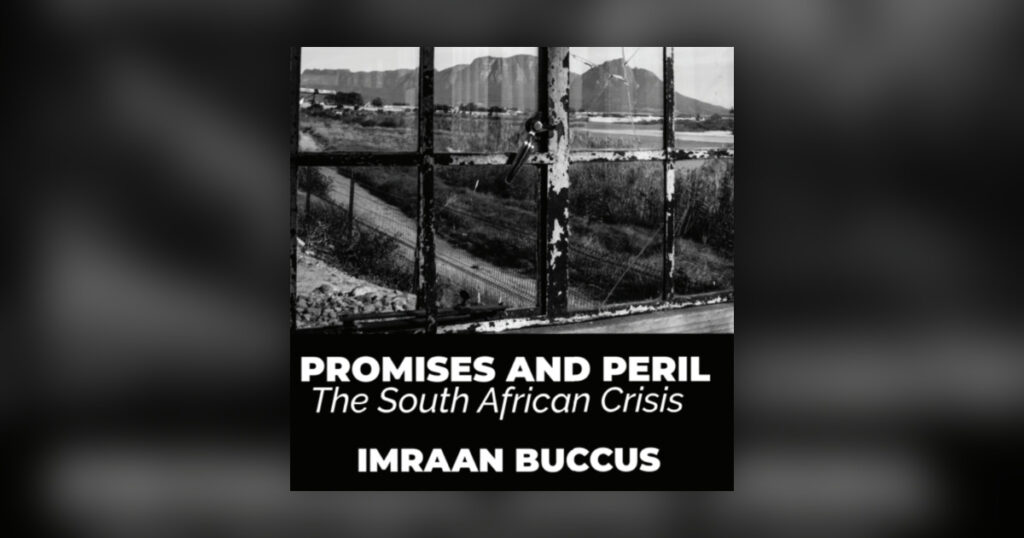
‘Politics and Peril, the South African Crisis’, a book by Al-Qalam editor, Dr Imraan Buccus, is being launched this week. Below is an extract from the introduction that links the personal to the political.
My journey into politics was intertwined with my search for meaning within Islam. I grew up in a religious Muslim home, and as a young boy, I began to grapple with what my faith had to say about the world around me — a world marked by deprivation, racial division, and injustice. I wanted to understand whether religion had anything to tell a young person living through apartheid. I remember going to the local imam and asking him about the oppression of Black people and what Islam’s position on this injustice was. His response was stark and unsettling: he dismissed my question as “kufr politics”.
That response lingered with me. It left me with the sense that something important was missing in how faith was being taught to us. My own father, who had only a primary school education, sensed my struggle. He introduced me to Fuad Hendricks, the then editor of Al-Qalam, a national Muslim newspaper whose political orientation was worlds apart from the conservative religious voices in my community. Hendricks presented a radically different image of Islam — one rooted in justice, struggle, and solidarity with the oppressed. He spoke of the Prophet (SAW) as someone who confronted injustice directly, who stood with the poor, and who challenged systems of exploitation. For the first time, I encountered a version of the faith that resonated with the world I lived in.



Hendricks encouraged me to attend the Muslim Youth Movement’s Islamic Training Programme in December 1989. That weekend was transformative. It was the first time I encountered the works of Ali Shariati, whose writings fused Islamic spirituality with radical social theory. Shariati captured something that had been forming within me for years: that the pursuit of justice is a religious act, and that the struggle against oppression is inseparable from spiritual devotion.
The programme also introduced me to two leading activists in the Muslim community, Na’eem Jeenah and Shamima Shaikh. Na’eem, in particular, shaped my political consciousness. In one discussion, he said something that has stayed with me throughout my life: “My spirituality is heightened when I am toyi-toying.” It was a simple but profoundly clarifying statement. It made visible the connections I had always felt intuitively but could never articulate — that protest, solidarity, and collective struggle could themselves be forms of worship, expressions of faith in action.
One of the most powerful moments from that period came when I first met Ahmed Kathrada, who had recently been released after 26 years in prison. Kathrada attended a gathering hosted by the Muslim Youth Movement. When he walked into the hall, young people erupted into song, forming a moving guard of honour as they toyi-toyied him into the room. I found myself standing next to him during Maghrib prayer. To be in prayer beside a man who had sacrificed so much — and who had emerged with his dignity, integrity, and humility intact — was electrifying. For many of us, it was a moment when political struggle, faith, and history converged in a single space.




The weekend programme also exposed the fractures and tensions within the Muslim community itself. Alongside the inspiring ideas and radical teachings were equally stark reminders of the contradictions within the community: gender hierarchies, racial prejudices, and the struggle between progressive and conservative currents. These tensions were not peripheral; they revealed the complex social terrain that shaped South African Islam during the final years of apartheid. Yet, even with these challenges, the Muslim Youth Movement provided a rare space where young people like myself could imagine an Islam that was intellectually alive, politically engaged, and deeply rooted in justice.
Looking back, that period was decisive. It was the moment when my political identity found its anchor in my religious identity. Islam, for me, ceased to be a set of private rituals and became a framework through which to understand — and confront — the world. It offered both moral clarity and emotional discipline. It insisted that neutrality in the face of injustice was impossible. It taught me that spiritual life and political life were not competing spheres but complementary obligations.
That insight shaped the path I would take from that moment forward. It informed my activism, my academic work, and my commitment to the struggles of working-class people in South Africa. It framed my understanding of solidarity not simply as a political choice but as a moral imperative. And it grounded my belief that the pursuit of justice — in all its messy, imperfect, and often painful forms — is a form of worship, a lived expression of faith.
The book will be available at Exclusive Books, Baitul Hikmah, Ikes Book Store, through Al-Qalam and ASRI, and online. Note, however, that it reaches Cape Town bookstores early next year.