Al-Qalam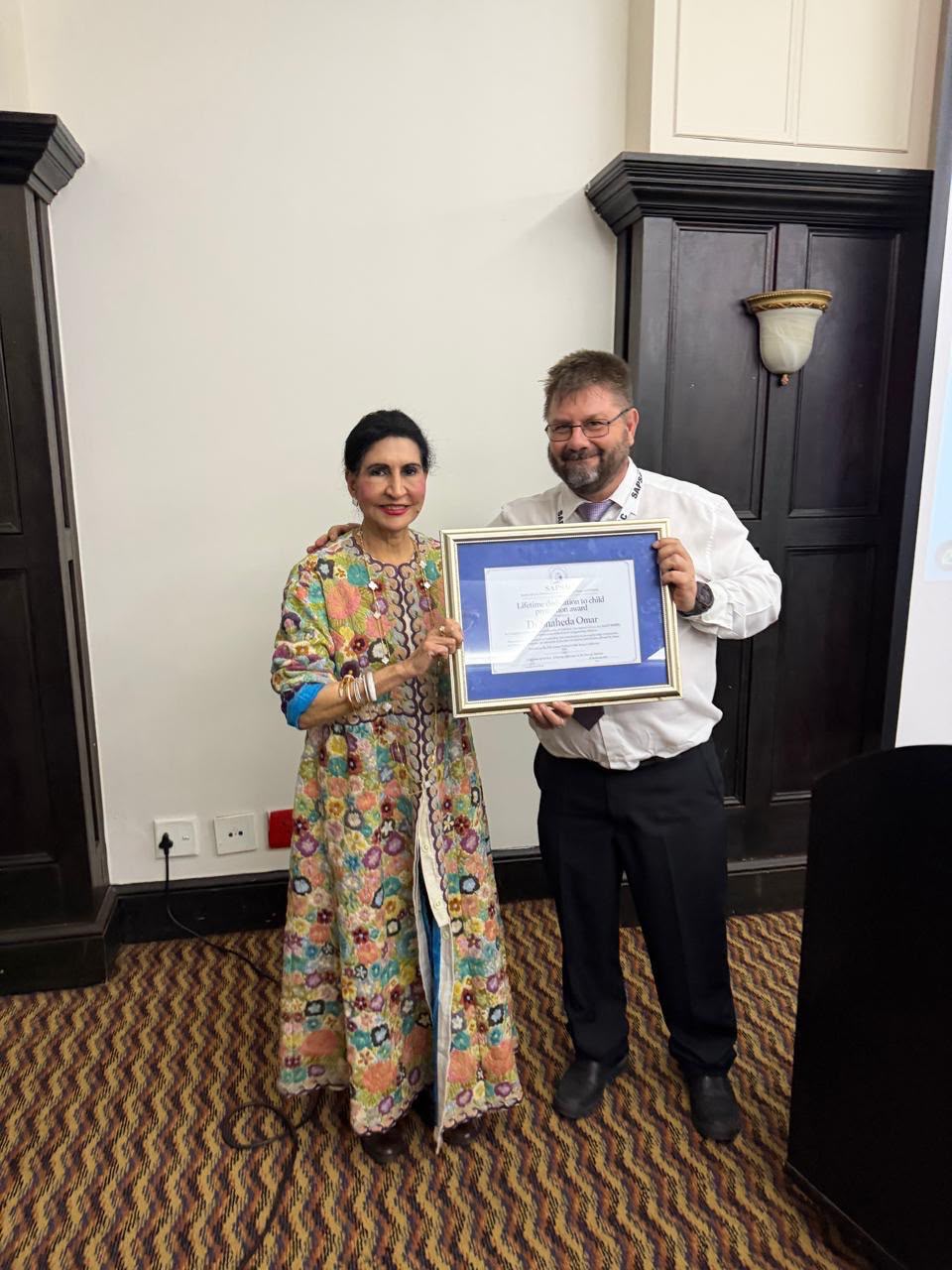
By Azra Hoosen
Dr Shaheda Omar, the Director of the Teddy Bear Foundation, was recently honoured with the Lifetime Dedication to Child Protection Award. She also received the Ahmed Kathrada Excellence in Leadership Award from the Congress of Business & Economics in September.
Speaking to Al-Qalam, Omar said that receiving the award was “deeply humbling”, but it is a reminder of the responsibility carried by those who work to protect children and support survivors, something that has become even more pressing as South Africa continues to grapple with violence against women and children. “I accept this award on behalf of every child whose courage has shaped my life and every person who has refused to give up on a child,” she said.
Her journey into child protection was not something she planned. Early in her career, she came to understand that children are often “the least powerful people in the room”, yet carry some of the greatest burdens.
Omar said children do not choose the families they are born into, nor do they choose poverty, violence, neglect or abuse. These circumstances, however, can profoundly shape their lives. “I realised that if we are serious about building a better society, we have to start by protecting our children,” she said.


Over the years, this sense of responsibility became a vocation. She came to understand that child protection was not simply about responding to abuse, but about restoring dignity, creating safety, strengthening families, preventing harm and ensuring that children have the opportunity to become the people they were meant to be.
Today, as South Africa continues to confront gender-based violence and femicide, Omar believes one of the biggest failures is that too much of the response comes after violence has already occurred. “We investigate the murder after a woman has been killed. We intervene after a child has been abused. We provide trauma support after the trauma has occurred. Of course, those responses are essential, but prevention has to begin much earlier,” she said.
She said violence against women and children is deeply interconnected: “A child who grows up witnessing violence against their mother is not simply witnessing an argument between adults. That child is experiencing violence too.”
When violence becomes normalised in a family, children can begin to see fear, shouting, threats, humiliation or physical violence as simply what family life looks like. “We therefore have to break the cycle early. Protecting women is also protecting children,” she stressed.
She believes prevention must become part of everyday life “in our homes, schools, communities, faith institutions and workplaces” rather than something discussed only during a crisis. “We must ask a much harder question – why are we continuing to place the responsibility for avoiding violence on the potential victim rather than placing responsibility on the person who chooses to perpetrate it?” she questioned.



While Omar has seen significant changes during her 40-year career, including greater public awareness, specialised services, stronger legislation, multidisciplinary approaches and greater recognition of children’s rights, she said progress on paper does not always translate into protection in practice.
For Omar, the question is whether those systems work “when a frightened child is sitting in front of us needing protection.”
The answer cannot simply be another policy. It must be “implementation, accountability and prevention”, alongside greater investment in parenting, early childhood development, schools, psychosocial support, healthy relationships, prevention programmes and safe communities.
She urged adults to pay attention to changes in children’s behaviour, including withdrawal, anxiety, aggression, changes in sleeping or eating, unexplained injuries, fear of a particular person or place and age-inappropriate sexualised behaviour.
She said that a lifetime in child protection was not measured by the number of years you have worked. It is measured by the number of children who, because you were there, were able to believe again that their lives could be different. “That is the honour I will carry with me for the rest of my life,” said Omar.